
Remanufacturing Report
: Analysis on the Market, Trends, and TechnologiesThe remanufacturing sector is maturing into a measurable commercial engine: the internal remanufacturing data forecasts a market projection of $5.92 billion by 2033 and a 4% CAGR for the core topic, validating steady expansion in capacity and activity. Broader market research shows the automobile remanufacturing segment growing much faster, with public forecasts that place the automotive remanufacturing market at roughly $63.1 billion in 2025 with a path to $143.2 billion by 2034 (CAGR 9.5%), indicating clear divergence between niche internal projections and larger sector-level growth drivers such as EV lifecycle needs and digital inspection technologies Automobile Remanufacturing Industry Outlook Report 2025-2034.
This report was last revised 126 days ago. See a missing piece? Your input can help — contact us.
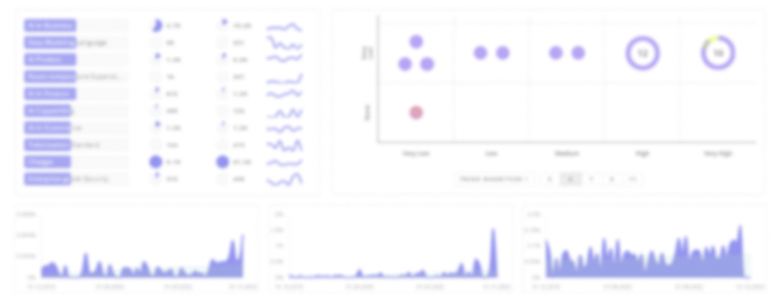
Topic Dominance Index of Remanufacturing
The Dominance Index for Remanufacturing delivers a multidimensional view by integrating data from three key viewpoints: published articles, companies founded, and global search trends
Key Activities and Applications
- Component-level restoration and precision resurfacing for high-value metal parts, using coordinated subtractive and additive cycles to return parts to original specifications.
- Remanufacture of automotive assemblies including engines, transmissions, turbochargers, starters and alternators as a primary volume activity driven by fleet maintenance economics Automotive Parts Remanufacturing - Global Strategic Business Report.
- Battery pack reconditioning, cell grading and power-electronics module refurbishment for electric vehicles, establishing new material-recovery and safety workflows Automobile Remanufacturing Market Report 2025.
- Reverse logistics and core management platforms that collect, grade, route and match returned cores to remanufacturing capacity to minimize lead times and inventory holding.
- Electronics and IC recovery services that extract, renew, and requalify semiconductors and populated boards to reduce supply risk and embodied carbon for OEMs and small repair houses.
Emergent Trends and Core Insights
- Market differentiation between high-value segments and legacy niches. Automotive and heavy equipment remanufacturing show high revenue growth in market forecasts while some specialist niches maintain only incremental expansion; firms must align portfolio strategy to where mass volumes meet high margin recovery opportunities.
- Digital traceability and product passports move from pilot to commercial requirement for B2B trust, warranty management, and regulatory compliance; projects building Digital Passports and marketplaces validate this shift for energy goods and large assemblies R3-MYDAS.
- Technology plays the central role in risk reduction. Automated inspection, machine learning for defect classification, and digital twins shorten decision cycles and raise certifiable quality to parity with new production for many classes of components.
- Materials strategy becomes strategic: recovery of critical raw materials and rare earths from industrial byproducts and e-waste reduces exposure to supply shocks and decarbonizes the value chain REMRETEch.
- Business model innovation toward Remanufacturing-as-a-Service (RaaS) and financing linked to circularity (sustainability-linked loans, green bonds) appears in patents and project descriptions as an emerging route to monetize guaranteed lifetime outcomes and carbon reductions.
Technologies and Methodologies
- Laser cladding and hybrid deposition for high-stress surface restoration, enabling rebuilds that meet fatigue and dimensional tolerance requirements for engine and gearbox components.
- Automated, AI-assisted non-destructive testing and computer vision inspection to quantify wear and generate process parameters for repair or replacement decisions.
- Digital twins and process-level Digital Passports that record provenance, test results, and repair histories to enable warranty-backed resale and regulatory reporting.
- Additive manufacturing for low-volume replacement parts and on-demand tooling, reducing lead times for obsolete components and enabling localized reman capacity Driving vehicle remanufacturing with additive innovation.
- Integrated ERP and reverse logistics platforms optimized for core flows, grading and pricing to reduce inventory waste and increase throughput across multi-site reman networks PRC Industries.
Remanufacturing Funding
A total of 437 Remanufacturing companies have received funding.
Overall, Remanufacturing companies have raised $5.4B.
Companies within the Remanufacturing domain have secured capital from 551 funding rounds.
The chart shows the funding trendline of Remanufacturing companies over the last 5 years
Remanufacturing Companies
IC Recovery
IC Recovery operates a Recovery-as-a-Service model that renews integrated circuits through a patented Chip-Renew™ process, claiming a 97% lower GHG footprint versus new fabrication and enabling reuse of ICs in repair and remanufacture workflows; this reduces OEM supply risk and embodied carbon for electronics remanufacturing providers.Refacture
Refacture deploys modular high-temperature plasma systems to recover strategic materials such as silicon carbide and synthetic graphite from industrial byproducts, positioning itself as a localized source of critical inputs for electrification supply chains and a partner for reman operations that need secure feedstocks.RESTORE
RESTORE develops hybrid deposition technologies (L-DED plus PTA) and recycled wire feedstock to scale large-component cladding for energy and heavy equipment remanufacturing, explicitly targeting zero-waste deposition loops and higher deposition rates for industrial parts.Reimagine Office Furnishings
Reimagine provides remanufactured office furniture and full decommissioning services with UL certification, enabling corporate customers to meet procurement and ESG targets while keeping high-value assets in use through certified remanufacture and resale channels.Metrofuser
Metrofuser combines returns management, remanufacturing and recommerce to serve OEMs and retailers in North America, operating an integrated core management model that shortens turnaround and increases yield from returned electronics and components.
TrendFeedr's Companies feature is your gateway to 4.4K Remanufacturing companies.
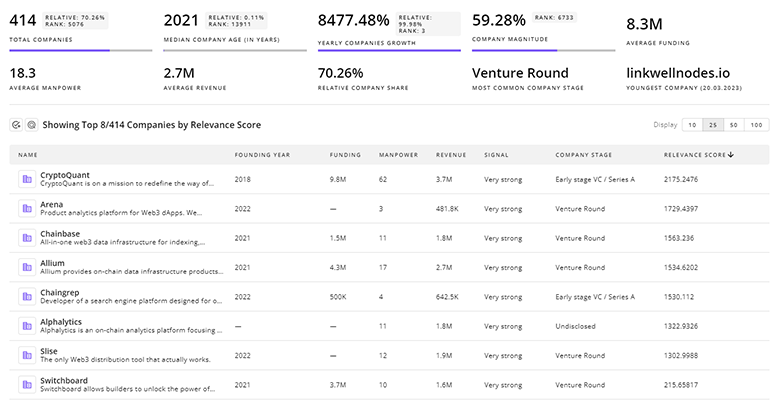
4.4K Remanufacturing Companies
Discover Remanufacturing Companies, their Funding, Manpower, Revenues, Stages, and much more
Remanufacturing Investors
The Investors tool by TrendFeedr offers a detailed perspective on 543 Remanufacturing investors and their funding activities. Utilize this tool to dissect investment patterns and gain actionable insights into the financial landscape of Remanufacturing.
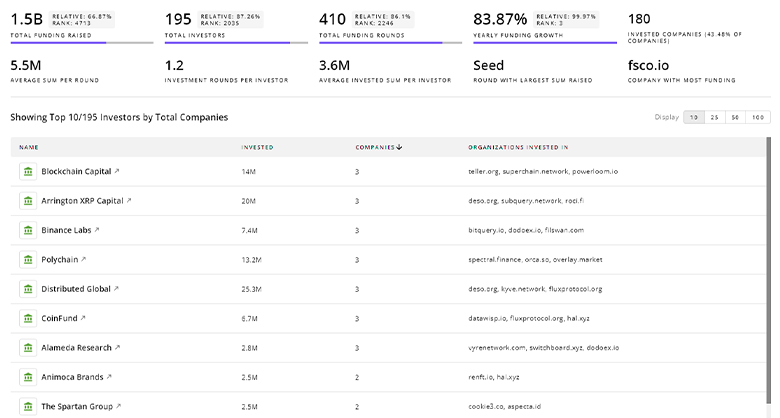
543 Remanufacturing Investors
Discover Remanufacturing Investors, Funding Rounds, Invested Amounts, and Funding Growth
Remanufacturing News
TrendFeedr’s News feature allows you to access 1.1K Remanufacturing articles as well as a detailed look at both historical trends and current market dynamics. This tool is essential for professionals seeking to stay ahead in a rapidly changing environment.

1.1K Remanufacturing News Articles
Discover Latest Remanufacturing Articles, News Magnitude, Publication Propagation, Yearly Growth, and Strongest Publications
Executive Summary
Remanufacturing now sits at the intersection of supply-chain resilience, cost containment and regulated decarbonization. The data shows two simultaneous dynamics. First, public market forecasts for automotive and medical imaging remanufacturing point to strong double-digit potential in selected segments as EV battery streams, automation and additive capabilities create new addressable markets. Second, internal topic metrics show more moderate aggregate growth for established reman niches, reflecting a fragmented field where scale, certification and traceability determine who captures higher margins. Practical strategic moves for industry actors include investing selectively in digital traceability and automated inspection to reduce quality risk, building materials recovery capabilities to secure critical feedstocks, and aligning commercial models to service contracts or RaaS constructs that monetize lifecycle outcomes rather than one-off sales. These priorities will separate firms that gain durable commercial advantage from those that remain price-sensitive commodity players.
Partner with us to offer cutting-edge insights into trends and tech. We welcome your input.