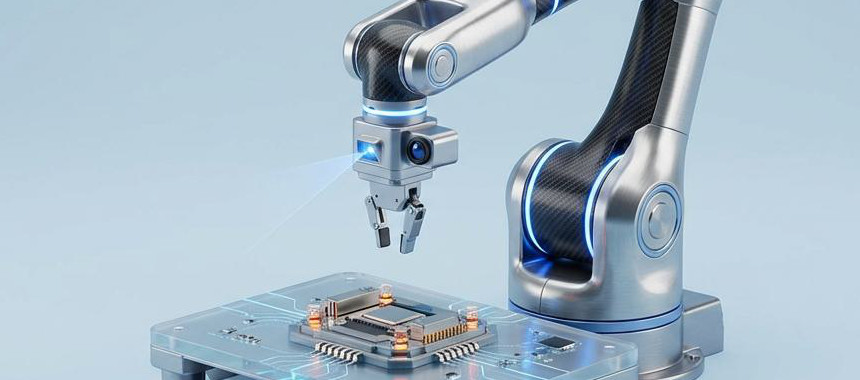
Smart Manufacturing Report
: Analysis on the Market, Trends, and TechnologiesThe smart manufacturing sector is on a steep growth trajectory: market data places the global market at $389,140,000,000 in 2025, growing at a 13.27% CAGR with a projected $619,340,000,000 by 2030. Demand is moving investment from isolated pilots to cross-site, cloud-linked stacks that combine IIoT telemetry, edge AI inference, and high-fidelity Digital Twin simulation to reduce downtime and compress cycle times; this shift forces manufacturers to prioritize integrated data pipelines, on-prem/edge deployment models, and operational cybersecurity to realize rapid, measurable ROI Scaling Smart Manufacturing with Cloud.
36 days ago, we last updated this report. Notice something that’s not right? Let’s fix it together.
Topic Dominance Index of Smart Manufacturing
To gauge the influence of Smart Manufacturing within the technological landscape, the Dominance Index analyzes trends from published articles, newly established companies, and global search activity
Key Activities and Applications
- Deploying pervasive IIoT sensor arrays and gateways for real-time condition monitoring and energy measurement; these feed both short-loop controls and enterprise analytics across MES layers Future of Manufacturing Market by Digital Factory.
- Implementing AI/ML for predictive maintenance and prescriptive quality control that materially cut unplanned downtime and scrap rates (manufacturers report order-of-magnitude reductions in critical stoppages when models are deployed at the edge) State of Smart Manufacturing Report.
- Building Digital Twins of processes and lines to simulate changes, validate process plans, and enable live closed-loop corrections that prevent defects before they occur.
- Moving MES/MOM functionality to cloud-native, modular platforms to enable multi-site benchmarking, traceability, and faster rollouts while retaining on-prem options for sovereignty and latency-sensitive controls.
- Converting machine sales into recurring revenue through servitization and Equipment-as-a-Service, using telemetry to support uptime guarantees, remote updates, and outcome-based contracts The Extent of Smart Manufacturing—Global Trends.
- Integrating ESG and energy-management telemetry into production control so that scheduling and process optimization explicitly trade off cost, throughput, and carbon—energy data now appears as a first-class input to production algorithms.
Emergent Trends and Core Insights
- Platform vs. Ingredient split: vendors either build end-to-end Manufacturing Operating Systems or specialize as high-value AI/vision/process-physics components that must integrate via open APIs; market concentration and funding patterns favor platform aggregation while margins for domain algorithms remain attractive.
- Edge AI adoption accelerates to remove latency and data-sovereignty bottlenecks for closed-loop control; manufacturers with sub-second control loops push models to the edge while using cloud for long-horizon analytics Powering the future of manufacturing.
- Sustainability is now an operational lever: energy and material metrics inform scheduling and maintenance, creating procurement advantages for suppliers who can prove lifecycle improvements Smart Factory Transformation.
- Human-centric automation: firms emphasize tools that augment frontline workers—digital work instructions, vision agents for assisted inspection, and AI decision aids—because adoption scales faster when operators retain agency and oversight Shaping the future with adaptive production.
- Cybersecurity and standards friction are the top scaling barriers; programs that package secure OT/IT integration with phased ROI measurements unlock buyer confidence IDC MaturityScape: Smart Manufacturing 3.0.
Technologies and Methodologies
- Industrial Internet of Things (IIoT) and edge gateways for deterministic telemetry and eventing.
- Digital Twin platforms for concurrent simulation, process validation, and scenario-based scheduling.
- AI/ML (Edge and Cloud) for predictive maintenance, prescriptive process control, and vision-based quality inspection.
- Cloud-native MES/MOM with modular APIs to support multi-site rollouts and cross-plant benchmarking while preserving on-prem options where required.
- No-code / low-code platforms to speed application delivery and reduce integration drag for brownfield factories.
- Vision AI Agents and automated inspection systems for high-throughput QA where human inspection limits yield SeeWise.AI.
Smart Manufacturing Funding
A total of 351 Smart Manufacturing companies have received funding.
Overall, Smart Manufacturing companies have raised $29.2B.
Companies within the Smart Manufacturing domain have secured capital from 1.2K funding rounds.
The chart shows the funding trendline of Smart Manufacturing companies over the last 5 years
Smart Manufacturing Companies
- Productive Machines — Productive Machines offers a digital twin-based learning platform for machining that links offline CAM simulation with online process monitoring to reduce trial-and-error setup time and cut cycle times by as much as 50% in published case work; the platform's closed-loop learning allows machine tools to share process improvements across a fleet, which suits job shops seeking immediate OEE gains.
- gemineers GmbH — gemineers provides a plug-and-play Digital Twin solution focused on metal cutting that converts CNC telemetry into actionable, ecological and productivity KPIs; the product is engineered for fast deployment on brownfield cells and emphasizes CO2 and material-use metrics to tie sustainability to shop-floor decisions.
- AmberRoad — AmberRoad brings field-proven, vertically integrated AI control systems developed inside a major steelmaker; the company highlights multiple live deployments with quantified gains (annualized profit uplift reported at multi-million dollar scales in steel operations) and a product approach that couples model governance with operations handover for sustained production value.
- Synctive — Synctive targets servitization and Equipment-as-a-Service for machinery OEMs by converting IoT telemetry into recurring service offerings and spare-parts intelligence; the firm's proposition suits OEMs seeking higher margin streams and improved aftermarket retention through data-driven service portfolios.
- StartProto AI Manufacturing OS — StartProto supplies a cloud-first manufacturing OS oriented to small and mid-sized shops, bringing together quoting, work scheduling, inventory, and real-time job tracking in a single platform to reduce ERP complexity and accelerate first-mile digital adoption; the UX focus and integrated traceability reduce implementation friction for resource-constrained manufacturers.
Get detailed analytics and profiles on 3.0K companies driving change in Smart Manufacturing, enabling you to make informed strategic decisions.
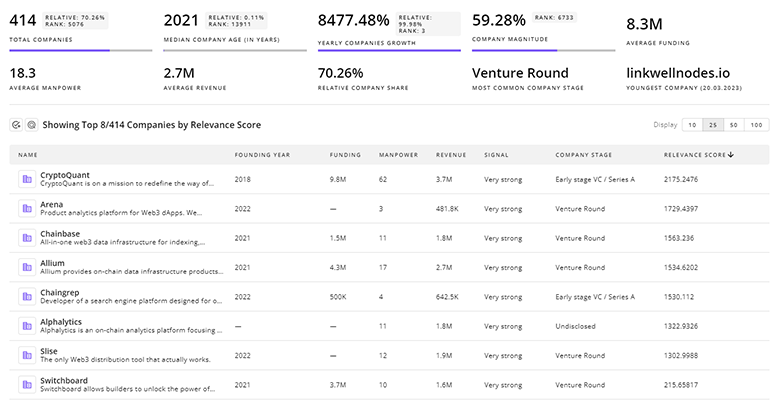
3.0K Smart Manufacturing Companies
Discover Smart Manufacturing Companies, their Funding, Manpower, Revenues, Stages, and much more
Smart Manufacturing Investors
TrendFeedr’s Investors tool provides an extensive overview of 1.6K Smart Manufacturing investors and their activities. By analyzing funding rounds and market trends, this tool equips you with the knowledge to make strategic investment decisions in the Smart Manufacturing sector.
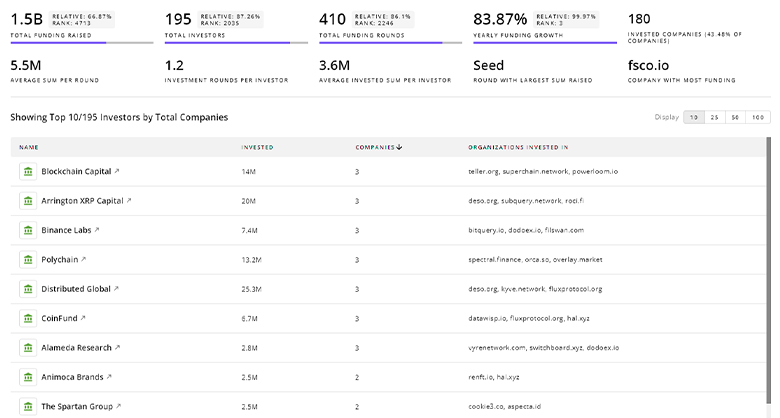
1.6K Smart Manufacturing Investors
Discover Smart Manufacturing Investors, Funding Rounds, Invested Amounts, and Funding Growth
Smart Manufacturing News
Explore the evolution and current state of Smart Manufacturing with TrendFeedr’s News feature. Access 6.0K Smart Manufacturing articles that provide comprehensive insights into market trends and technological advancements.
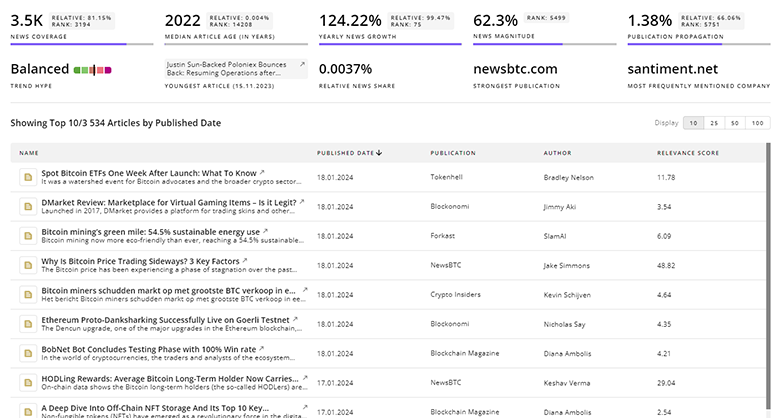
6.0K Smart Manufacturing News Articles
Discover Latest Smart Manufacturing Articles, News Magnitude, Publication Propagation, Yearly Growth, and Strongest Publications
Executive Summary
Critical findings show that smart manufacturing now centers on data convergence rather than isolated automation. Firms that combine reliable OT data capture, edge AI for control, and cloud analytics for cross-site learning will convert pilots into production value fastest. Energy and sustainability metrics are no longer optional inputs; they now shape scheduling and CAPEX decisions. The practical play for operators and investors is to prioritize API-first MES/MOM platforms that enable modular adoption, pair those platforms with validated domain AI providers, and invest in workforce tools that embed operator context into automated decision loops. This combination reduces scaling friction, secures predictable ROI, and positions organizations to compete on both efficiency and compliance.
We're looking to collaborate with knowledgeable insiders to enhance our analysis of trends and tech. Join us!