Supply Chain Report
: Analysis on the Market, Trends, and TechnologiesThe supply chain market is shifting from isolated visibility projects to integrated, AI-driven network orchestration where resilience and real-time decisioning determine competitive advantage; this change is funded at scale — the Supply Chain Automation market was $9,300,000,000 in 2024 and is projected to reach $25,400,000,000 by 2030. Companies that pair multi-tier data harmonization with digital-twin scenario testing and targeted automation are reducing exposure to supplier shocks while improving inventory velocity and service outcomes.
290 days ago, we last updated this report. Notice something that’s not right? Let’s fix it together.
Topic Dominance Index of Supply Chain
To gauge the influence of Supply Chain within the technological landscape, the Dominance Index analyzes trends from published articles, newly established companies, and global search activity
Key Activities and Applications
- Deploy AI-powered demand forecasting and prescriptive inventory control to convert visibility into measurable stock reductions and service-level gains across planning and execution layers.
- Build control towers and real-time monitoring systems that ingest IoT and multimodal tracking data to drive event management and exception remediation.
- Implement digital twin modelling for stress-testing network designs and supply disruptions; use scenario outputs to set contingency buffers and regional sourcing policies.
- Introduce procurement automation and supplier risk scoring to automate RFQ lifecycles, sanctions screening, and dynamic supplier substitution when tier-n disruption signals appear.
- Integrate sustainability measurement into day-to-day operations (product passports, carbon attribution) so sourcing and logistics choices reflect both cost and compliance risk.
Emergent Trends and Core Insights
- Data harmonization is the gating factor. Platforms that consolidate BOMs, transactional flows, and IoT feeds into a single truth layer become the foundation for automation and optimization.
- Network thinking replaces linear chain thinking. Organizations design for multi-party flows and excess capacity sharing rather than single-node control, requiring multi-enterprise orchestration platforms.
- Agentic and LLM-powered decisioning will mainstream quickly. Predictions show widespread adoption of LLM/agent platforms for risk simulation, compliance automation, and scenario planning within a two- to three-year horizon IDC FutureScape: Worldwide Supply Chain 2025 Predictions.
- Near-shoring and multi-sourcing are now operational imperatives, driven by tariff volatility, geopolitical friction, and the cost of failure; selective regionalization reduces single-source risk while preserving cost control Thematic Intelligence: Supply Chain Disruption (2024).
- Sustainability has migrated from reporting to decision logic; digital twins and traceability systems now quantify upstream carbon and enable procurement trade-offs based on verified impact.
Technologies and Methodologies
- AI/ML forecasting and prescriptive optimization — moving planning from periodic to continuous, enabling automatic order adjustments and dynamic safety-stock settings.
- Digital twins and simulation platforms for end-to-end scenario planning and ROI validation of network changes.
- Blockchain / Verified Data Fabrics to create tamper-evident provenance and speed trade finance and compliance workflows across partners.
- Edge IoT + control towers for low-latency telemetry, condition monitoring (cold-chain), and live exception routing.
- No-code/low-code orchestration to accelerate business-owned workflow configuration and reduce integration lead times for procurement-to-payment and fulfillment flows.
- Operations research and hierarchical optimization (multi-resolution planning) to balance global strategy with local execution constraints, enabling elastic, objective-driven plan recalculation.
Supply Chain Funding
A total of 27.0K Supply Chain companies have received funding.
Overall, Supply Chain companies have raised $3.3T.
Companies within the Supply Chain domain have secured capital from 90.0K funding rounds.
The chart shows the funding trendline of Supply Chain companies over the last 5 years
Supply Chain Companies
- - SupplyVue — SupplyVue provides a cloud digital-twin platform that models production cycles and end-to-end network response so planners can test and select mitigation scenarios rather than react under pressure. The product focuses on scenario transparency: outputs explain why options change KPIs, not just what the optimizer recommends. Its small, expert team targets mid-sized manufacturers and offers tight coupling between simulation and change design
- - SCIP — SCIP is an AI-agent first platform that consolidates and cleans fragmented BOM and vendor data to create a single source of truth; it automates bidding, identifies part alternatives, and surfaces risk signals that materially reduce procurement cycle times. The company's product replaces legacy seat-based procurement tools with unlimited-seat deployment models, making enterprise-wide data integrity practical for complex manufacturers
- - Supply Chain Wizard — Supply Chain Wizard specializes in serialization, traceability, and regulatory implementations for life-sciences customers, combining managed services with IoT and blockchain to deliver compliant end-to-end solutions. The firm pairs consultancy with platform delivery to shorten the path to DSCSA/serialization readiness and real-time cold-chain assurance
- - Chainlane — Chainlane delivers a cloud RFID and item-level visibility stack that drives retail and high-value goods accuracy, enabling real-time stock reconciliation and loss reduction. Its focus on rapid retail deployments and integration with POS and WMS systems drives measurable uplifts in sell-through and shrink control for omnichannel operators
- - Shiperone — Shiperone provides a no-code orchestration layer for freight, container and last-mile workflows that lets operations teams automate complex multimodal processes in days instead of months. The platform emphasizes easy integration, templated workflows, and live collaboration — a practical entry point for companies seeking rapid automation with low IT overhead
Get detailed analytics and profiles on 245.7K companies driving change in Supply Chain, enabling you to make informed strategic decisions.
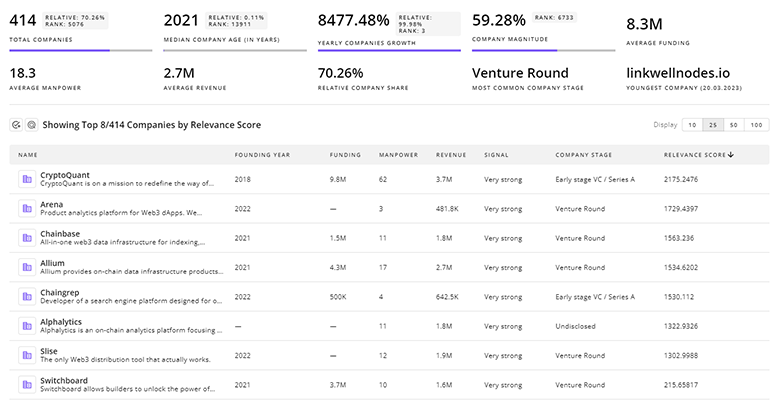
245.7K Supply Chain Companies
Discover Supply Chain Companies, their Funding, Manpower, Revenues, Stages, and much more
Supply Chain Investors
TrendFeedr’s Investors tool provides an extensive overview of 59.7K Supply Chain investors and their activities. By analyzing funding rounds and market trends, this tool equips you with the knowledge to make strategic investment decisions in the Supply Chain sector.
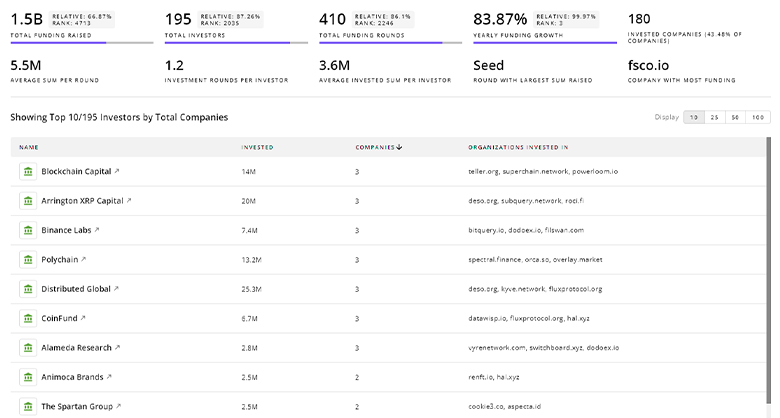
59.7K Supply Chain Investors
Discover Supply Chain Investors, Funding Rounds, Invested Amounts, and Funding Growth
Supply Chain News
Explore the evolution and current state of Supply Chain with TrendFeedr’s News feature. Access 253.7K Supply Chain articles that provide comprehensive insights into market trends and technological advancements.
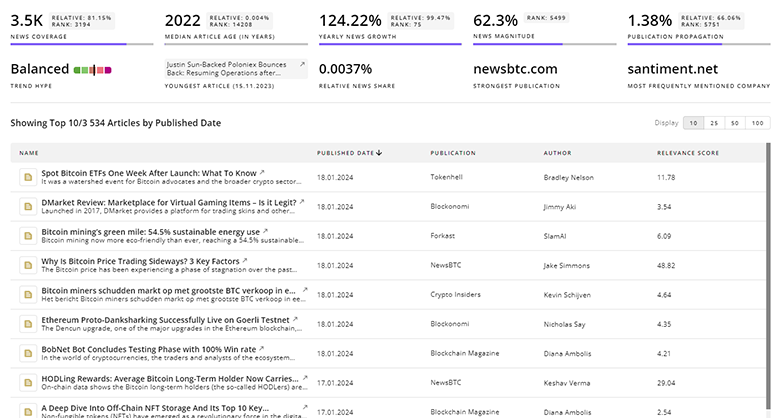
253.7K Supply Chain News Articles
Discover Latest Supply Chain Articles, News Magnitude, Publication Propagation, Yearly Growth, and Strongest Publications
Executive Summary
Investment and attention must move from isolated visibility projects and point automation to an integrated architecture that enforces data quality, supports continuous simulation, and enables agentic decisioning across partner boundaries. Strategic priorities for executives are clear: consolidate multi-tier data into a single trusted layer, operationalize digital twins to make regionalization and multi-sourcing decisions defensible, and adopt modular automation (no-code orchestration plus targeted robotics) that yields measurable ROI. Firms that sequence these actions — first fixing data and governance, then adding simulation and automated execution — will compress time to resilience and convert supply-chain investments into sustained service and margin advantages.
We're looking to collaborate with knowledgeable insiders to enhance our analysis of trends and tech. Join us!