Telecommunications Report
: Analysis on the Market, Trends, and TechnologiesThe telecommunications sector is reorienting from raw footprint expansion toward data-driven monetization of networks, led by cloud-native stacks, Open RAN adoption, edge compute and satellite augmentation; the internal trend report records a market CAGR of 7.0% and a forecasted market size of $3,703,600,000,000 by 2033. This combination of steady CAGR and strong technology adoption places premium value on software, geospatial intelligence, and high-efficiency specialist vendors that can be embedded into carrier stacks rather than competing purely on capacity Telecommunications services – statistics.
34 days ago, we last updated this report. Notice something that’s not right? Let’s fix it together.
Topic Dominance Index of Telecommunications
To gauge the influence of Telecommunications within the technological landscape, the Dominance Index analyzes trends from published articles, newly established companies, and global search activity
Key Activities and Applications
- Fiber and FTTH rollout — building last-mile capacity to support higher fixed broadband ARPU and enterprise SLAs; this remains a top application area for operators and new entrants.
- 5G base station and small cell deployment — densification to enable low-latency services for industry IoT and mobile broadband, driving equipment and site-build demand.
- Cloud-native core & virtualization (NFV/SDN) — migration of OSS/BSS and core functions to containerized, microservices architectures to reduce OPEX and accelerate service launches.
- Private networks and enterprise FWA — designing and operating campus/private 5G and fixed wireless access for manufacturing, logistics and public-safety customers.
- Satellite-augmented connectivity (LEO/NTN) — integrating LEO/MEO links into hybrid access strategies to cover remote routes and provide resilience for maritime and rural markets.
- Revenue assurance, TEM and fraud management — auditing and protecting telco margins via real-time analytics, mediation and billing platforms that recover and secure operator revenue.
- Geospatial infrastructure intelligence — mapping fiber, tower and PoP assets into GIS systems for planning, monetization and regulatory strategy.
- Lifecycle and circular-economy equipment services — refurbish, logistics and resale channels that reduce CAPEX for operators and hedge supply-chain risk.
Emergent Trends and Core Insights
- Platformization of telco offerings — operators move from connectivity-only to integrated cloud, security and data platforms; capturing higher-margin B2B services depends on software and partner ecosystems Telecom Market Research, 2025.
- Open RAN and disaggregation — adoption increases vendor choice and software innovation; procurement and interoperability now determine deployment speed and TCO.
- AI/ML integrated into network operations — predictive maintenance, dynamic slicing and QoE optimization move from pilots to production, compressing OPEX and improving customer SLAs.
- Hybrid connectivity architectures (fiber + 5G + LEO) — operators will package multi-access solutions for resilience and coverage expansion, notably in maritime and remote enterprise segments.
- Security and insurance as core procurement criteria — cyber risk and service continuity drive insurance and vendor selection; the telecom insurance market is expanding with projected double-digit CAGR in specialized coverage.
- Geographic divergence in investment profiles — mature markets focus on optimization and monetization, while emerging markets prioritize capacity build-out and universal access funded by public programs.
- Supply-chain and component risk awareness — dependence on optical and RF component suppliers in East Asia elevates the value of circular-economy players and local manufacturing options.
Technologies and Methodologies
- Open RAN (O-RAN) — disaggregated radio access enabling multi-vendor stacks and software-based RIC platforms; critical for cost control and innovation.
- Network Function Virtualization (NFV) & Software-Defined Networking (SDN) — enable agile service instantiation and reduce vendor lock-in for core functions.
- Edge computing & Multi-access Edge Compute (MEC) — place compute and AI inference near users for low-latency services (AR/VR, industrial control).
- AI/ML-driven automation — predictive maintenance, anomaly detection and dynamic resource allocation that materially reduce OPEX and improve network availability.
- LEO/MEO satellite integration and NTN (direct-to-device) — supplement terrestrial coverage and support maritime, mobility and emergency services.
- Advanced optical and fiber techniques — GPON/WDM PON, fiber-deep and non-disruptive last-mile methods using robotics for faster FTTH rollouts.
- Spectrum efficiency and smart-spectrum management — tools and consultancy to maximize spectral value and regulatory compliance LS telcom.
- Revenue assurance and TEM platforms — CDR reconciliation, mediation and fraud prevention that directly protect operator margins CODECOMPASS.
Telecommunications Funding
A total of 22.6K Telecommunications companies have received funding.
Overall, Telecommunications companies have raised $2.8T.
Companies within the Telecommunications domain have secured capital from 70.8K funding rounds.
The chart shows the funding trendline of Telecommunications companies over the last 5 years
Telecommunications Companies
- Verveba Telecom — Verveba Telecom offers specialized RAN engineering, Open RAN integration, and cell-site automation tools targeted at operators and enterprises executing 5G transformations; the firm emphasizes rapid deployment, antenna analytics and cell-site automation to shorten time-to-service and reduce on-site costs. Verveba positions itself as a systems integrator for private networks and indoor coverage, capturing enterprise and neutral-host projects.
- SEE Telecom — SEE Telecom specializes in confined-area critical radio coverage (tunnels, metros, offshore platforms) and repeaters engineered for safety and public-safety networks; its products reduce installation complexity in constrained environments and align to regulated public-protection use cases. This focus creates a defensible niche where reliability and certification matter more than scale.
- GeoTel Communications, LLC — GeoTel Communications digitizes fiber, tower and lit-building footprints into GIS and SaaS products that accelerate network planning, site selection and competitor analysis; carriers and investors use GeoTel maps to prioritize fiber densification and identify monetization corridors. The company's geospatial intelligence converts physical assets into strategic decision support, shortening commercial cycles for infrastructure projects.
- Telicomm — Telicomm develops adaptive video-over-cellular software that optimizes live video streams for limited bandwidth cellular links, targeted at smart-city camera deployments and public-safety applications; its real-time adaptation reduces transport costs and enables new use cases for cellular-based video services. By addressing the high-bandwidth pain point for video, Telicomm offers a clear operational ROI for municipalities and integrators.
- SUACONCEPT PRO (VC TELECOMS) — SUACONCEPT PRO (formerly VC TELECOMS) applies non-destructive last-mile deployment techniques—installing fiber via sewer tunnels and robotic methods—to accelerate FTTH installs in dense urban zones while minimizing civil disruption; this method materially shortens deployment timelines and reduces permitting friction in constrained rights-of-way. Their approach targets markets where conventional trenching costs and permissions block rapid fiber expansion.
Get detailed analytics and profiles on 347.6K companies driving change in Telecommunications, enabling you to make informed strategic decisions.
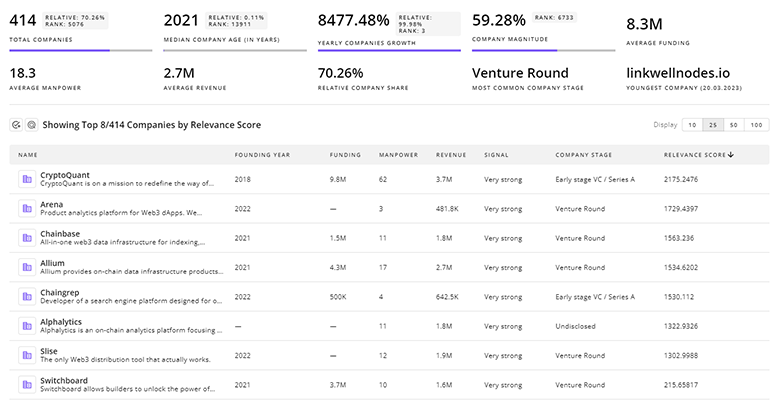
347.6K Telecommunications Companies
Discover Telecommunications Companies, their Funding, Manpower, Revenues, Stages, and much more
Telecommunications Investors
TrendFeedr’s Investors tool provides an extensive overview of 47.0K Telecommunications investors and their activities. By analyzing funding rounds and market trends, this tool equips you with the knowledge to make strategic investment decisions in the Telecommunications sector.
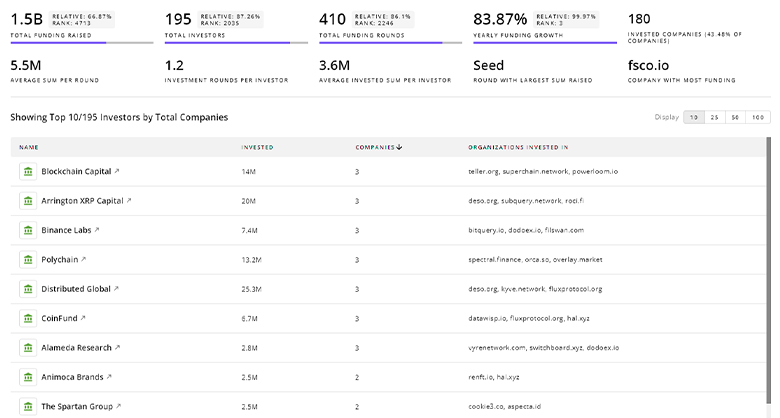
47.0K Telecommunications Investors
Discover Telecommunications Investors, Funding Rounds, Invested Amounts, and Funding Growth
Telecommunications News
Explore the evolution and current state of Telecommunications with TrendFeedr’s News feature. Access 616.6K Telecommunications articles that provide comprehensive insights into market trends and technological advancements.
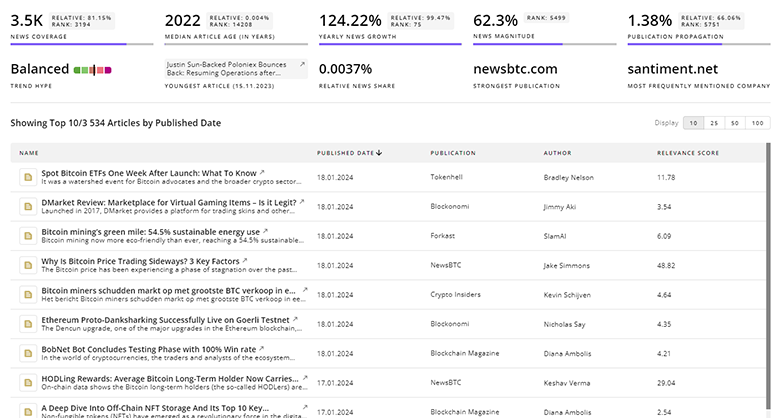
616.6K Telecommunications News Articles
Discover Latest Telecommunications Articles, News Magnitude, Publication Propagation, Yearly Growth, and Strongest Publications
Executive Summary
Investment priorities in telecommunications now reward software-first, data-enabled capabilities layered on top of physical networks rather than pure capacity plays. Operators that convert fiber and spectrum into packaged platform services—bundling cloud access, security and vertical-specific SLAs—will capture higher-margin B2B revenue. For vendors and startups, the two defensible routes are (1) become an indispensable ingredient embedded into carrier stacks (revenue assurance, site automation, geospatial intelligence), or (2) own specialized, mission-critical engineering where certification and reliability create barriers to entry. In parallel, managing supply-chain exposure through refurbished equipment channels and local deployment innovations provides practical hedges against component scarcity and geopolitical risk.
We're looking to collaborate with knowledgeable insiders to enhance our analysis of trends and tech. Join us!