Wind Report
: Analysis on the Market, Trends, and TechnologiesThe wind sector is accelerating into a data-and-design split where software-driven yield gains compete directly with new hardware architectures: the market shows a 27.87% CAGR metric reported in wind trend data, signaling concentrated investor appetite for rapid scale and technological change. Global market forecasts project expansion from USD 174.5 billion in 2024 toward triple-digit growth over the next decade, driven by offshore auctions and high-altitude concepts that reprice where and how capacity is built Wind Energy Market Size, Growth Outlook 2025-2034 – GMInsights. This bifurcation produces two investment vectors: (1) immediate LCOE compression through sensing, forecasting, and active flow control; and (2) longer-term displacement of towered HAWTs by airborne and advanced VAWT designs that change the material and installation economics Wind – IEA.
248 days ago, we last updated this report. Notice something that’s not right? Let’s fix it together.
Topic Dominance Index of Wind
To understand the relative impact of Wind relative to other known Trends and Technologies, our Dominance Index examines three correlated timelines: the volume of articles published, the number of companies founded, and the intensity of global search interest.
Key Activities and Applications
- Utility-scale onshore and offshore wind — large farm development, repowering projects, and grid integration remain primary value pools; offshore auctions and floating platforms are unlocking deep-water sites Wind industry installs record capacity in 2024 despite policy instability - GWEC.
- Short-horizon operational optimization — sub-minute nowcasting and nacelle-forward sensing enable dynamic pitch/yaw/torque control to increase AEP and reduce mechanical stress, especially on aging fleets.
- Airborne Wind Energy (AWE) and high-altitude systems — tethered kites, autonomous wings, and glider concepts target stronger, steadier winds above conventional rotor heights to lower material intensity per MW.
- Distributed, urban and modular turbines — vertical-axis and variable-geometry designs aim at siting in complex wind fields (urban canyons, suburban corridors), enabling on-demand generation and microgrid coupling VAYU®.
- O&M digitization and predictive maintenance — fleet monitoring, digital twins, drone inspection and AI predictive alerts reduce downtime and extend component life, producing direct ROI on existing assets MDWind.
Emergent Trends and Core Insights
- Data is replacing scale as the fastest path to LCOE reduction. Software and sensing—nowcasting, nacelle LiDAR, and farm-level optimization—are producing measurable AEP uplifts and load reductions that compound across fleets.
- Offshore continues to grow but regionally divergent deployment persists. China and Asia-Pacific concentrate the bulk of new capacity while the U.S. saw a slowdown in 2024 installation volumes, creating arbitrage between policy-enabled markets and those constrained by permitting or commodity cycles WWEA Annual Report 2024: A Challenging Year for Windpower.
- Airborne and advanced VAWT architectures are moving from lab to field demonstration. Multiple pilots and funding rounds show AWE and counter-rotating VAWTs progressing from concept risk toward commercial pilots, but regulatory and safety hurdles remain the gating factors WorldWideWind.
- Blade lifecycle and ESG compliance are emerging as financing preconditions. Recyclable blade materials and circular-economy treatments now influence project bankability and tender outcomes.
- Operational resilience is now a strategic differentiator. Extreme weather and atmospheric complexity reduce expected yields; investments in storm-resistant designs, icing mitigation and resilient foundations command premium valuation adjustments Land-Based Wind Market Report: 2024 Edition - Berkeley Lab.
Technologies and Methodologies
- Active Flow Control (AFC) and blade surface modulation — dynamic aerodynamic surfaces deliver step gains in capacity factor and help manage fatigue loads; AFC vendors target single-digit to mid-teens percent yield improvements.
- Nacelle-mounted and farm-level LiDAR / remote sensing — pre-gust wind data enables earlier pitch/yaw actions and lowers gearbox/stress events, yielding 1-3% AEP increases in field trials Windar Photonics A/S.
- High-fidelity CFD coupled with AI — micro-siting and wake interaction modeling now combine CFD with machine learning to produce bankable, site-specific yield models and reduce layout uncertainty WindSim AS.
- Airborne systems: tether, control, and ultralight materials — automated flight control stacks and fatigue-resistant tethers cut material needs dramatically versus towered systems, enabling lower capex per MW for specific use cases Kitepower.
- Floating foundation and semisubmersible platforms — TLPs, WindFloat®, and modular mooring approaches unlock deep-water sites where capacity factors and distance economies favor large turbines.
- Robotics and inspection drones, plus digital twins — these reduce downtime and optimize maintenance schedules for large offshore assets, shifting OPEX profiles in favor of data-rich operators.
Wind Funding
A total of 5.8K Wind companies have received funding.
Overall, Wind companies have raised $1.5T.
Companies within the Wind domain have secured capital from 17.5K funding rounds.
The chart shows the funding trendline of Wind companies over the last 5 years
Wind Companies
- Windscape AI — Windscape AI provides ultra-short nowcasts ( 15-60 seconds) using a low-cost Wi-Fi mesh of environmental sensors and ML to feed SCADA systems; the solution targets immediate revenue uplift and reduced mechanical wear by enabling preemptive pitch/yaw corrections. Their field-proven, patented approach seeks to convert near-term atmospheric certainty into quantifiable asset performance gains, making retrofit economics attractive to operators managing legacy fleets.
- Hyper Wind — Hyper Wind develops active flow control systems for blade surfaces that report up to +15% in energy capture and claim LCOE reductions near 10% from aerodynamic modulation; the company pairs aerodynamic hardware with validation programs to replace incremental rotor improvements with control-led yield gains.
- W'wave — W'wave deploys WindWave concentrator hardware that modifies local flow to increase turbine density and per-turbine output (claims up to 35% localized uplift); their physical field-augmentation approach offers a capital-light way to increase production inside existing footprints, targeting asset owners seeking short path to higher yield.
- Windswept and Interesting — Windswept and Interesting builds networked airborne kite turbines and emphasizes modular, portable AWE nodes for remote or temporary power needs; their small-fleet focus aims at rapid deployment where conventional towers are impractical.
- Windcity — Windcity offers variable-geometry turbines designed for low-speed and urban wind regimes, accelerating start-up from 2 m/s conditions and enabling hybrid integration with PV and battery in constrained sites; their circular-economy language and small-footprint models position them for municipal and distributed energy projects.
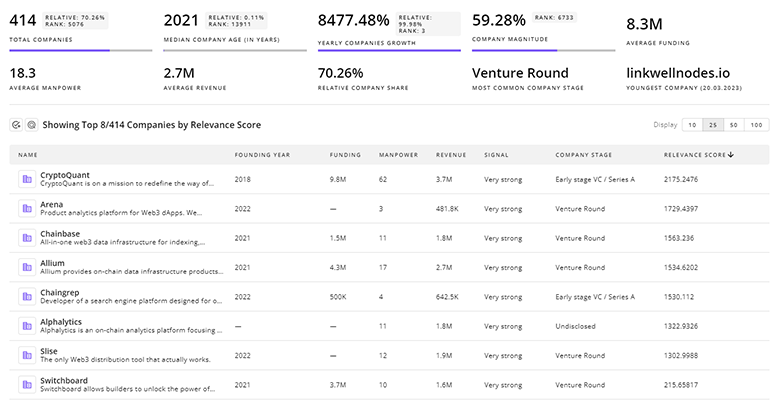
TrendFeedr’s Companies feature offers comprehensive insights into 69.4K Wind companies.
69.4K Wind Companies
Discover Wind Companies, their Funding, Manpower, Revenues, Stages, and much more
Wind Investors
TrendFeedr’s Investors tool offers you a detailed perspective into 13.0K Wind investors and their funding activities. This information enables you to analyze investment trends and make informed decisions in the Wind market.
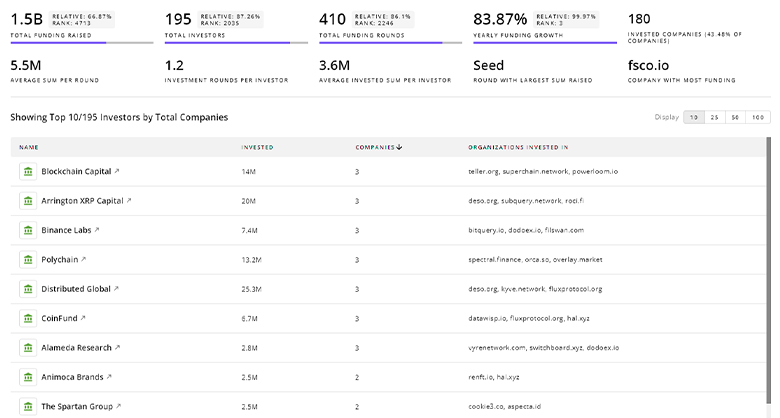
13.0K Wind Investors
Discover Wind Investors, Funding Rounds, Invested Amounts, and Funding Growth
Wind News
TrendFeedr’s News feature delivers access to 192.0K articles focused on Wind. Use this tool to stay informed about the latest market developments and historical context, which is crucial for strategic decision-making.
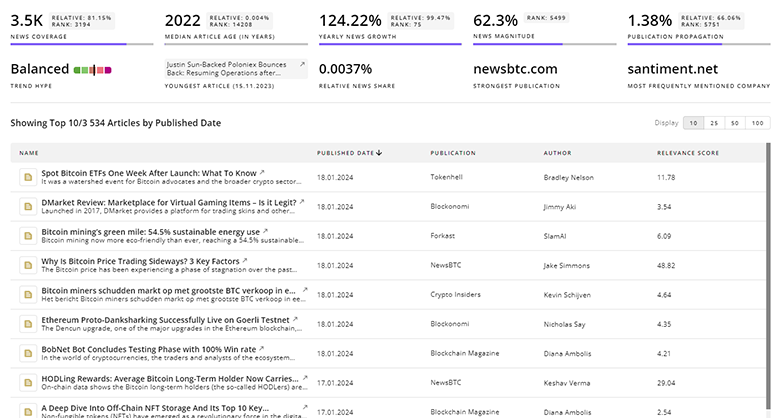
192.0K Wind News Articles
Discover Latest Wind Articles, News Magnitude, Publication Propagation, Yearly Growth, and Strongest Publications
Executive Summary
The immediate value in wind lies less in simply adding swept area and more in turning uncertain wind into guaranteed output. Investors and operators who control short-horizon forecasts, ahead-of-gust sensing, and active aerodynamic control can extract outsized returns from existing fleets while reducing stress-related capex. Parallel to that, airborne and advanced vertical architectures present a credible route to materially lower material intensity per megawatt, but they remain subject to safety, certification, and regulatory timelines. For project sponsors, the practical playbook is twofold: invest in operational intelligence to lift short-term returns and selectively back validated hardware innovations that solve lifecycle and siting constraints; for policy makers and financiers, tying tenders and offtake to blade lifecycle plans and verified resilience metrics will become a gating requirement for capital deployment.
We're looking to collaborate with knowledgeable insiders to enhance our analysis of trends and tech. Join us!