
Air Defense System Report
: Analysis on the Market, Trends, and TechnologiesThe air defense market is consolidating around software-defined sensing and non-kinetic neutralization even as legacy procurement slows: total funding across air-defense companies stands at $21.62B and the topic shows accelerating technology adoption despite net declines in company and patent growth. Recent market forecasts place medium-term sector growth in the high single digits (example projection: USD 25.82 billion by 2031, 7.85% CAGR) as directed-energy and AI-native sensor fusion expand procurement budgets and operational concepts Air Defense Systems Market Size, Growth & Trends 2031.
This report was last updated 131 days ago. Spot an error or missing detail? Help us fix it by getting in touch!
Topic Dominance Index of Air Defense System
To identify the Dominance Index of Air Defense System in the Trend and Technology ecosystem, we look at 3 different time series: the timeline of published articles, founded companies, and global search.
Key Activities and Applications
- Integrated Sensor Fusion for IADS — Combining radar, EO/IR, acoustic and space-based feeds to create continuous threat tracks and automated cueing chains for interceptors and non-kinetic effectors; this is core to current procurement cycles and platform upgrades
- Layered Interception (SHORAD / MRAD / LRAD) — Fielding complementary short-, medium- and long-range layers to cover drone swarms, cruise missiles and ballistic/hypersonic threats; MRAD shows outsized adoption as militaries seek range vs. cost balance.
- Counter-UAS (C-UAS) Operations — Rapid deployment of multi-sensor C-UAS kits (radar + RF + EO/IR + soft-kill jammers / cyber takeover) for critical infrastructure, forces protection and event security; portable and mobile packages are expanding procurement beyond major bases.
- Directed-Energy Interception — Tactical lasers and high-power microwaves enter operational evaluations to reduce per-engagement cost and supply constraints associated with kinetic missiles; several national tests and prototypes are now public Air-Based Defense Market Size, Share… 2025.
- Space-Enabled Early Warning & ADS-B Surveillance — Spaceborne ADS-B and satellite sensors extend tracking to maritime, polar and remote corridors, improving cueing for theatre missile defense and intercept timelines Aireon LLC.
- Supply-Chain Verification & Lifecycle Services — Increased use of secure provenance systems and long-term maintenance contracts to mitigate counterfeit parts and delivery delays in high-value air defense programs.
Emergent Trends and Core Insights
- AI-Native Sensing and Decisioning — Firms embedding neural networks inside radar and signal processing stacks, rather than applying AI post-detection, are improving low-RCS detection and reducing false positives, producing measurable performance gains in field tests
- Shift Toward Non-Kinetic, Low-Collateral Responses — Legal and operational limits in urban and critical-infrastructure settings favor cyber takeover and targeted RF defeat over hard-kill engagements, accelerating adoption of soft-kill tactics in procurement roadmaps.
- Autonomous, cooperative interception architectures are maturing: smaller effectors (interceptor drones, directed energy, jammers) will increasingly operate under distributed C2 with prioritized task allocation to maximize magazine depth and reduce human latency.
- Regional Sovereignty Drives Procurement Choices — Europe and Asia are prioritizing sovereign solutions (European MRAD/long-range programs, domestic C-UAS stacks) to reduce export control friction and ensure interoperability aligned with regional alliances Air Defense System Market.
- Commercial-to-Defense Technology Flows — Startups exploiting commercial radar, AI signal stacks and active-electronically scanned array (AESA) modules are compressing modernization cycles; venture capital is flowing into sensor-fusion and C-UAS startups even as overall company counts decline in the legacy segments
Technologies and Methodologies
- AI-Driven Radar Signal Processing — Deep learning applied to IQ and range-Doppler feeds enhances detection of low-RCS and small-slow targets, improving track continuity for multi-sensor fusion
- 3D MIMO & AESA Radar Architectures — Multi-beam MIMO radars deliver volumetric coverage and improved clutter rejection essential for dense urban C-UAS deployments and SHORAD packages.
- Passive Acoustic Vector Sensing — Acoustic particle-velocity sensors provide non-emitting detection for small arms and UAVs with low SWaP, giving a covert sensing layer that cue active radar systems
- Directed-Energy & HPM Effectors — Tactical lasers and high-power microwave systems offer deep magazine and low marginal cost per engagement; procurement pilots and firm-level scale-ups are visible in recent contracts and investments
- Cyber-Takeover & RF Deceptive Techniques — Non-destructive mitigation that seizes command links and forces safe landing is becoming a preferred approach over indiscriminate jamming in regulated airspace.
- Digital Twin & Predictive Sustainment — Model-based development and AI decision-support for maintenance lower lifecycle costs and shorten upgrade cycles for high-value interceptors and radar arrays.
Air Defense System Funding
A total of 64 Air Defense System companies have received funding.
Overall, Air Defense System companies have raised $21.6B.
Companies within the Air Defense System domain have secured capital from 169 funding rounds.
The chart shows the funding trendline of Air Defense System companies over the last 5 years
Air Defense System Companies
- Advanced Protection Systems Inc. — APS produces the SKYctrl modular C-UAS package built around FIELDctrl 3D MIMO radars and multi-band soft-kill jammers with a stated detection range up to 6000 m, tailored for critical infrastructure protection. The system emphasizes low false-alarm rates through advanced signal processing and automatic radio-directive jamming cued by radar tracks, enabling scalable perimeter defense for airports and power plants
- Axon Pulse — Axon-Pulse offers AI-first radar signal processing libraries that run in real time on constrained hardware to increase detection range, resolution and classification for existing radars; their approach allows legacy platforms to receive performance upgrades via software patches rather than full hardware replacements, shortening field modernization cycles
- Microflown AVISA — Microflown commercializes acoustic particle-velocity sensors and the AMMS node for passive three-dimensional acoustic awareness across ground and airborne nodes; their passive sensor net provides a low-signature cueing layer that reduces RF exposure and improves detection of small UAVs and incoming indirect-fire events
- AeroDefense — Specializes in passive RF detection and spectrum analytics with the AirWarden® product line, offering both low-cost Remote-ID capture and advanced spectrum sensors to detect homemade or non-broadcasting drones; AeroDefense targets public-safety and correctional facility markets with certified, fielded SBIR and DHS designations that ease procurement paths
- Vigilant Aerospace Systems, Inc. — Provides the FlightHorizon detect-and-avoid and UTM/DAA software stack based on licensed NASA IP to enable BVLOS and safe integration of UAS into shared airspace; their software fuses transponder, radar and live traffic feeds to produce automated avoidance advisories and strategic deconfliction for commercial and governmental operators
Identify and analyze 476 innovators and key players in Air Defense System more easily with this feature.
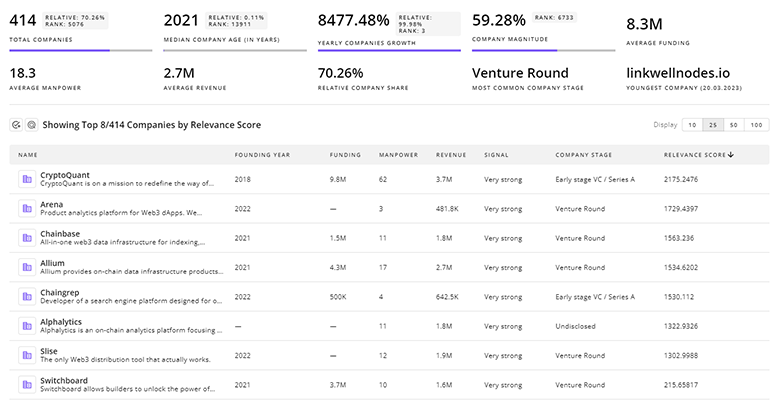
476 Air Defense System Companies
Discover Air Defense System Companies, their Funding, Manpower, Revenues, Stages, and much more
Air Defense System Investors
TrendFeedr’s investors tool offers a detailed view of investment activities that align with specific trends and technologies. This tool features comprehensive data on 162 Air Defense System investors, funding rounds, and investment trends, providing an overview of market dynamics.
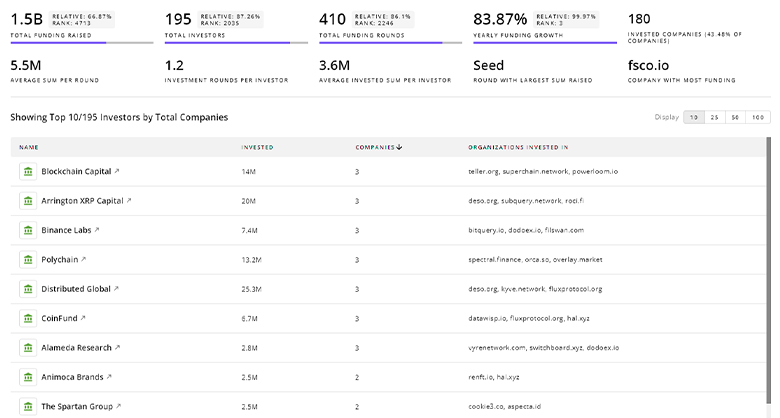
162 Air Defense System Investors
Discover Air Defense System Investors, Funding Rounds, Invested Amounts, and Funding Growth
Air Defense System News
Stay informed and ahead of the curve with TrendFeedr’s News feature, which provides access to 5.7K Air Defense System articles. The tool is tailored for professionals seeking to understand the historical trajectory and current momentum of changing market trends.

5.7K Air Defense System News Articles
Discover Latest Air Defense System Articles, News Magnitude, Publication Propagation, Yearly Growth, and Strongest Publications
Executive Summary
Investment and operational priority in air defense now cluster around three capabilities: software-first sensor fusion that improves detection and classification, non-kinetic neutralization approaches that reduce collateral risk and operating cost, and modular architectures that permit rapid capability insertion. Market momentum flows to vendors who can upgrade existing radars and command systems with AI software, integrate directed-energy and soft-kill layers, and certify predictable sustainment and supply-chain provenance. For procurement leaders the clear strategic play is to rebalance capex away from single-purpose kinetic inventories toward multi-layered, software-defined suites that lower per-engagement costs and compress upgrade timelines.
Interested in enhancing our coverage of trends and tech? We value insights from experts like you - reach out!