Decentralized Lending Report
: Analysis on the Market, Trends, and TechnologiesThe decentralized lending market shows a clear inflection: the internal data records a 2024 market size of $3.6 billion and a long-term forecast to $425 billion by 2035, signaling that product innovation—not mere token speculation—is driving structural market expansion. Investor flows reflect renewed confidence (Q2 2024 capital deployments reached $306.78 million per the funding landscape), and protocol-level work on tokenized collateral, AI underwriting, and cross-chain liquidity is converting that investment into new product classes and distribution channels. Together these forces compress time-to-scale for permissionless lending products while creating sharper regulatory and security demands for market participants.
We updated this report 356 days ago. Noticed something’s off? Let’s make it right together — reach out!
Topic Dominance Index of Decentralized Lending
The Topic Dominance Index trendline combines the share of voice distributions of Decentralized Lending from 3 data sources: published articles, founded companies, and global search
Key Activities and Applications
- Peer-to-peer marketplaces that match retail and institutional capital directly with borrowers, reducing intermediary layers and enabling novel credit-product packaging.
- Decentralized credit scoring and underwriting that combine on-chain activity, alternative off-chain signals and ML models to price undercollateralized exposure and expand access to thin-file borrowers.
- NFT-backed and digital-asset collateralization, enabling liquidity against unique digital collectibles and tokenized real-world assets (RWA) without asset sale.
- Fixed-rate and auction-based lending services that deliver predictable loan terms and protect counterparties from rate slippage via algorithmic auctions and locked-rate pools.
- Cross-chain lending protocols and multi-pool liquidity arrangements that move collateral and credit across blockchains to aggregate supply and lower funding costs.
- Embedded lending for SMBs where lending is offered at the point of sale or via B2B platforms, turning existing merchant and accounting data into rapid credit decisions.
Emergent Trends and Core Insights
- AI-first underwriting: ML models consume broader datasets (on-chain flows, transaction histories, behavioral signals) to increase approval rates while attempting to contain default risk; this materially expands addressable borrowers versus legacy credit models.
- Tokenization of debt and RWA integration: protocols are creating tradable debt tokens and RWA-backed lending markets, shifting liquidity dynamics and enabling portfolio-level risk allocation on-chain.
- Under-collateralized lending primitives: zk- and reputation-assisted mechanisms plus off-chain credit oracles enable reduced collateral requirements for retail borrowers, but they concentrate counterparty and oracle risk.
- Fixed-rate and auction mechanics gain product-market fit as institutional and cautious retail users demand predictable cashflows, prompting growth of auction-based fixed-rate pools.
- Convergence with regulated finance: banks and fintechs increasingly partner with DeFi primitives to gain distribution while meeting licensing regimes; regulatory clarity will determine how fast on-chain credit scales into mainstream balance sheets researchandmarkets – 2025.
- Security and operationalization risk remains the dominant constraint: smart contract bugs, oracle failures, and liquidity stresses can trigger large contagion events unless protocols harden insurance and layered-risk controls thebusinessresearchcompany – 2025.
Technologies and Methodologies
- Smart contracts and programmable money markets that automate origination, collateral management, interest accrual and liquidations.
- Zero-knowledge proofs and zk-native designs to enable privacy-preserving credit signals and to compress proof sizes for scalable L2 lending.
- AI/ML underwriting stacks that fuse on-chain telemetry, alternative off-chain data, and behavioral features for real-time risk scoring and automated decisioning.
- Tokenization frameworks for RWAs and debt tranches, enabling fractionalization and on-chain securitization that create tradable loan instruments and secondary liquidity.
- Cross-chain bridges, liquidity aggregators and multi-pool architectures that reduce fragmentation and allow capital to be redeployed where yields are most efficient.
- Oracle and governance mechanisms (on-chain or hybrid) to feed reliable pricing, identity attestations and off-chain credit events into smart contracts; these are critical failure points to design around.
Decentralized Lending Funding
A total of 162 Decentralized Lending companies have received funding.
Overall, Decentralized Lending companies have raised $4.3B.
Companies within the Decentralized Lending domain have secured capital from 499 funding rounds.
The chart shows the funding trendline of Decentralized Lending companies over the last 5 years
Decentralized Lending Companies
-
Solend — Solend operates an algorithmic money market on Solana that offers permissionless lending and borrowing with programmatic interest rate models. The protocol has focused on capital efficiency in a high-throughput environment and serves as a working example of chain-native lending market design.
Citation: -
Liquid Loans — Liquid Loans provides a stablecoin-minting model where users lock native chain tokens to mint a USD-pegged asset and borrow with time-insensitive repayment terms. The protocol targets users who want liquidity without selling core holdings and emphasizes non-custodial, governance-minimized operation.
Citation: -
ZeroLend — ZeroLend builds Layer 2-focused lending rails that aim to remove intermediaries and lower transaction friction. Its roadmap centers on permissionless pools and minimized admin control to deliver transparent yields and borrowing options on L2s.
Citation: -
Lendica — Lendica targets embedded SMB lending, integrating underwriting into merchant workflows and using platform telemetry to offer near-instant B2B credit. The company focuses on underwriting automation and API-first distribution to enable non-financial platforms to offer financing.
Citation: marketresearchfuture – 2025 -
Hashstack — Hashstack develops a zk-native money market on Starknet that enables highly capital-efficient, under-collateralized borrow positions using zero-knowledge proofs for risk attestation. The approach targets retail-scale under-collateralized lending with cryptographic assurances and L2 cost efficiency.
Citation:
Gain a better understanding of 431 companies that drive Decentralized Lending, how mature and well-funded these companies are.
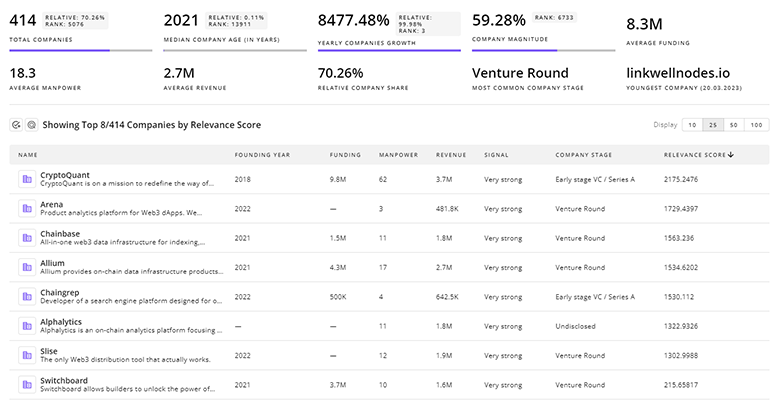
431 Decentralized Lending Companies
Discover Decentralized Lending Companies, their Funding, Manpower, Revenues, Stages, and much more
Decentralized Lending Investors
Gain insights into 1.6K Decentralized Lending investors and investment deals. TrendFeedr’s investors tool presents an overview of investment trends and activities, helping create better investment strategies and partnerships.
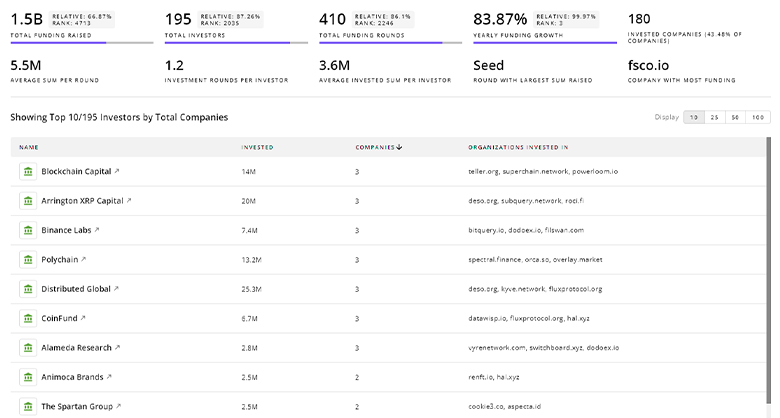
1.6K Decentralized Lending Investors
Discover Decentralized Lending Investors, Funding Rounds, Invested Amounts, and Funding Growth
Decentralized Lending News
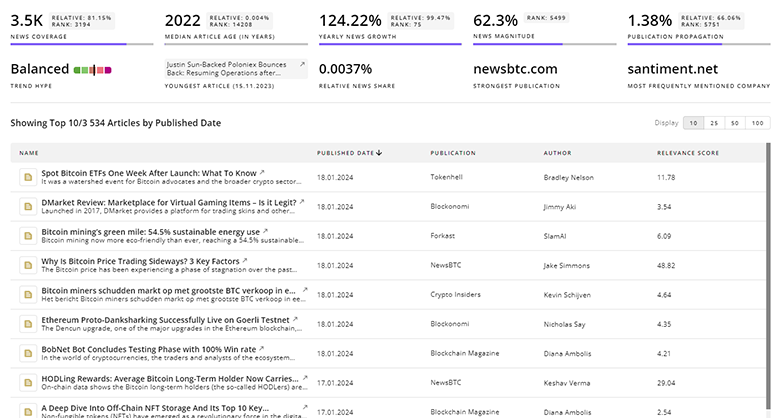
Gain a competitive advantage with access to 1.3K Decentralized Lending articles with TrendFeedr's News feature. The tool offers an extensive database of articles covering recent trends and past events in Decentralized Lending. This enables innovators and market leaders to make well-informed fact-based decisions.
1.3K Decentralized Lending News Articles
Discover Latest Decentralized Lending Articles, News Magnitude, Publication Propagation, Yearly Growth, and Strongest Publications
Executive Summary
Decentralized lending is moving from experimental primitives toward structured product stacks that can appeal to both retail and institutional users. Key short-term opportunities sit at the intersection of AI-driven credit decisioning, tokenized collateral that unlocks new liquidity pools, and embedded distribution into merchant and SMB workflows. The principal execution risks are security (smart contract and oracle failures), regulatory alignment as protocols interface with regulated capital, and liquidity fragmentation across chains. Market participants that combine rigorous risk engineering, credible off-chain partnerships, and clear governance will be positioned to convert current investor interest into sustainable market share.
We seek partnerships with industry experts to deliver actionable insights into trends and tech. Interested? Let us know!