Digital Identity Report
: Analysis on the Market, Trends, and TechnologiesThe digital identity landscape is at a crossroad where technology adoption accelerates even as company and patent growth moderate, evidenced by $30.54B in total funding across 6,044 active companies and an expansive content base of 10,001 articles, signaling concentrated capital and attention in a maturing set of solutions. Market forecasts reinforce rapid expansion: total market projections range into the hundreds of billions over the next decade (for example, USD 132.14B by 2031 at a 20% CAGR) Digital Identity Solutions Market worth $132.14 billion by 2031. The practical implication is clear: enterprises and governments will adopt integrated identity orchestration platforms and privacy-preserving verification in parallel, creating two commercial frontiers—high-assurance, compliance-driven orchestration and privacy-first, self-sovereign models—each backed by measurable investment and standards activity.
We updated this report 213 days ago. Noticed something’s off? Let’s make it right together — reach out!
Topic Dominance Index of Digital Identity
The Topic Dominance Index trendline combines the share of voice distributions of Digital Identity from 3 data sources: published articles, founded companies, and global search
Key Activities and Applications
- High-assurance onboarding and KYC/AML verification: Identity platforms integrate document capture, biometric liveness checks, and third-party watchlists to meet enterprise compliance needs; financial services and regulated industries remain the largest commercial adopters.
- Digital identity wallets and credential management: Wallets store Verifiable Credentials (VCs) and enable selective attribute disclosure for user-centric workflows in both consumer and public-sector use cases.
- Decentralized/self-sovereign identity (SSI) deployments: DIDs and VCs are used to issue reusable credentials for Web3, healthcare, and government pilots where data minimization and user control are primary requirements Digital Identity: Solutions Assessment, Regional Analysis & Market Forecasts 2023-2027.
- Biometric and behavioral authentication across lifecycles: Passive and active biometrics (face, fingerprint, voice, behavioral patterns) are applied for both onboarding and continuous session assurance to reduce account takeover and fraud NEC Biometrics: No Cards, No Keys, No Problem.
- Identity orchestration and API hubs (IDaaS/ID orchestration): Firms build single-integration gateways that unify eIDs, document verification, biometrics, and fraud engines to lower integration costs and accelerate deployments for enterprises Digital Identity Solution Market - By Component.
- Credentialing for education and workforce: Tamper-evident digital certificates and badges enable skills portability and employer verification, tying identity primitives to workforce mobility and credential marketplaces Digital Badges Market.
Emergent Trends and Core Insights
- Consolidation around orchestration: Platforms that provide a single integration point for multiple verification methods (OCR, eID, biometrics, fraud scoring) are becoming acquisition targets for enterprise vendors looking to simplify compliance stacks.
- Privacy-first cryptography is commercially viable: Zero-Knowledge Proofs and selective disclosure shift the tradeoff between verification strength and PII exposure, creating practical paths for privacy-preserving KYC and attribute verification.
- AI both fuels and fights fraud: Generative AI increases synthetic-identity and deepfake threats, while AI/ML models become essential for liveness detection, anomaly scoring, and adaptive authentication; vendors investing in large-scale trust signals gain measurable conversion and fraud-reduction advantages.
- Regulatory framing is a demand driver: eIDAS 2.0, GDPR derivatives, and financial KYC/AML mandates push enterprises toward certified credential flows and interoperable trust frameworks, accelerating wallet and eID integrations in Europe and North America EU Digital Identity Wallet: Challenges and Opportunities.
- Non-human identity surfaces expand rapidly: Machine and device identities (IoT, service accounts) require new lifecycle and certificate-management models, creating parallel product paths for identity vendors.
- Addressable market polarization: Large incumbents capture the high-assurance enterprise spend while smaller, focused insurgents (SSI, ZKP specialists) capture privacy-centric verticals and developer ecosystems; both cohorts will attract targeted investor interest as standards and pilots scale.
Technologies and Methodologies
- Decentralized Identifiers (DIDs) and Verifiable Credentials (VCs): W3C-driven primitives enabling cryptographically verifiable, selective-attribute sharing for user-controlled wallets.
- Zero-Knowledge Proofs (ZKP) and Secure Multi-Party Computation (sMPC): Techniques that enable attribute verification without exposing raw PII, increasingly integrated into KYC and credential flows for privacy-first use cases.
- AI/ML-powered verification and fraud engines: Models for document forgery detection, deepfake liveness tests, and behavioral anomaly scoring that improve conversion while lowering fraud loss.
- Mobile device as hardware-backed token: Use of TEEs, platform attestation, and PKI on smartphones to create hardware-grade credentials without separate tokens.
- Identity orchestration (ID Hubs / IDaaS): API-first orchestration layers that normalize eIDs, biometrics, document verification, and fraud signals into reusable workflows for enterprise integration.
- Continuous and behavioral authentication: Session-level assurance using device telemetry and behavior patterns to maintain trust post-login and reduce reliance on static second factors Callsign.
Digital Identity Funding
A total of 788 Digital Identity companies have received funding.
Overall, Digital Identity companies have raised $30.5B.
Companies within the Digital Identity domain have secured capital from 3.2K funding rounds.
The chart shows the funding trendline of Digital Identity companies over the last 5 years
Digital Identity Companies
- Outdid – Outdid applies Zero-Knowledge Proofs to verify government-issued documents without storing PII, enabling fully private, trustless checks for Web2 and Web3 platforms. The company targets scenarios where minimal data disclosure is a regulatory or user-experience requirement, replacing third-party attestations with cryptographic proofs. Its approach reduces verifier liability and supports use cases from age gating to on-chain verification. Outdid's model aligns with rising demand for privacy-preserving KYC and selective disclosure.
- Sedicii – Sedicii builds collaborative identity platforms using ZKPs and sMPC to let organizations verify attributes without exchanging underlying data. The company serves financial services and regulated enterprises focused on confidential data collaborations and cross-institutional KYC checks. Sedicii's backing from public and strategic investors underscores adoption interest in cryptographic privacy layers for compliance workflows.
- EarthID – EarthID offers a standards-aligned decentralized identity platform with ISO27001 and GDPR certifications that focuses on tamper-evident credentials, tokenization of PII, and privacy-preserving verification. The startup targets enterprises seeking wallet-based credential exchange and data minimization for customer onboarding and fraud reduction. EarthID's emphasis on certification and public-sector trust signals fits markets where compliance plus user control matter.
- Authologic – Authologic provides an eID Hub API that aggregates government eIDs, bank IDs, document OCR, and biometric checks into a single integration point for global KYC and onboarding. This orchestration-first model addresses enterprise pain from multiple vendor integrations and speeds regional deployments by exposing normalized flows to customers. Authologic's value proposition suits banks and telecom operators needing global coverage with local compliance controls.
- Dock Labs – Dock Labs builds decentralized credential infrastructure and ID wallet tooling to enable reuse and monetization of verifiable credentials across partner networks. Its Truvera platform focuses on cross-silo verification and consistent user identity views across enterprises, reducing repeat verification friction. Dock Labs targets both developer ecosystems and enterprise credential markets that demand interoperable VC issuance and verification.
Gain a better understanding of 6.0K companies that drive Digital Identity, how mature and well-funded these companies are.
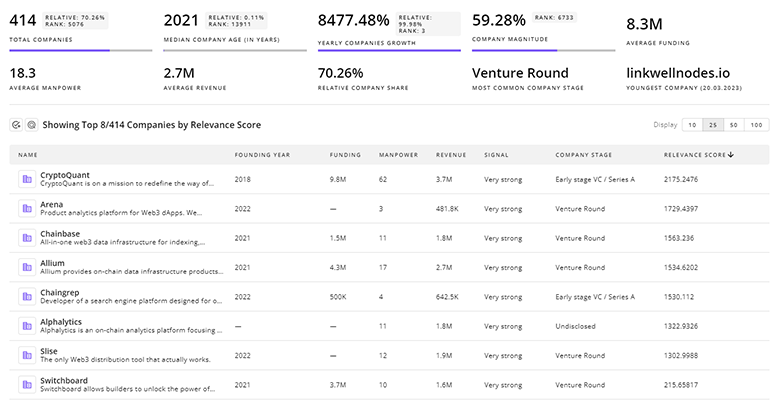
6.0K Digital Identity Companies
Discover Digital Identity Companies, their Funding, Manpower, Revenues, Stages, and much more
Digital Identity Investors
Gain insights into 3.9K Digital Identity investors and investment deals. TrendFeedr’s investors tool presents an overview of investment trends and activities, helping create better investment strategies and partnerships.
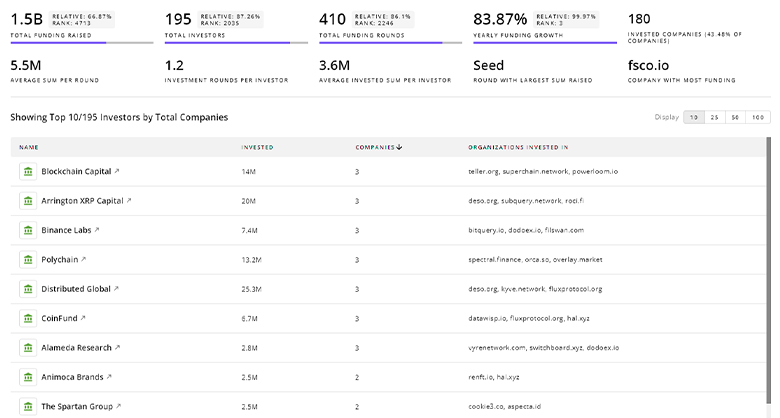
3.9K Digital Identity Investors
Discover Digital Identity Investors, Funding Rounds, Invested Amounts, and Funding Growth
Digital Identity News
Gain a competitive advantage with access to 10.0K Digital Identity articles with TrendFeedr's News feature. The tool offers an extensive database of articles covering recent trends and past events in Digital Identity. This enables innovators and market leaders to make well-informed fact-based decisions.
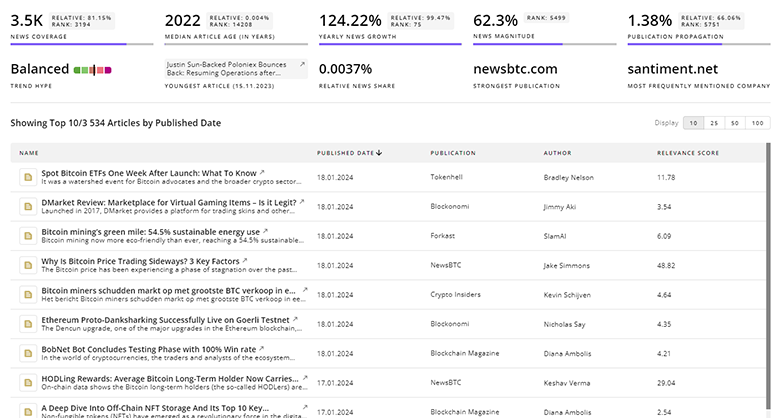
10.0K Digital Identity News Articles
Discover Latest Digital Identity Articles, News Magnitude, Publication Propagation, Yearly Growth, and Strongest Publications
Executive Summary
The digital identity market is splitting into two commercially viable directions: enterprise-focused orchestration that meets compliance and scale needs, and privacy-first decentralized models that eliminate PII exposure and enable selective disclosure. Investment patterns and standards maturation show both tracks will coexist; success will depend on a vendor's ability to integrate regulatory certification, strong fraud detection (AI/ML), and privacy-enhancing cryptography into coherent developer experiences. For businesses, the strategic priority is to design identity roadmaps that support interoperable credential standards and API-based orchestration while piloting privacy-preserving flows where regulatory or customer trust concerns demand them.
We seek partnerships with industry experts to deliver actionable insights into trends and tech. Interested? Let us know!