
Immersive Learning Report
: Analysis on the Market, Trends, and TechnologiesThe immersive learning market is scaling fast and now represents a major enterprise training vector: the internal trend data values the immersive-training market at USD 16.4 billion in 2024 with a projected CAGR of 28.3% to reach about USD 69.6 billion by 2030, signalling rapid commercial adoption in high-value training verticals. External market forecasts vary (conservative to aggressive), but they converge on sustained double-digit growth driven by hardware maturity, AI-enabled personalization, and enterprise demand for measurable skill transfer Immersive Technology Market Overview Immersive Training Market Size & Share, Growth Report 2034. The data available shows the immediate commercial runway is led by safety, medical and skilled-trades training while platform economics are shifting from hardware dependence to software, analytics, and AI-driven content pipelines.
The last update of this report was 135 days ago. If you spot incomplete or incorrect info, please let us know.
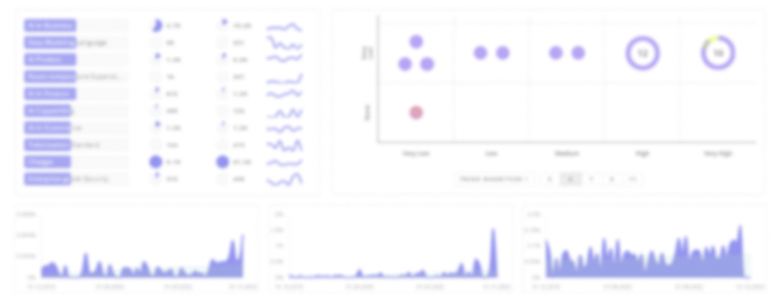
Topic Dominance Index of Immersive Learning
The Topic Dominance Index analyzes the time series distribution of published articles, founded companies, and global search data to identify the trajectory of Immersive Learning relative to all known Trends and Technologies.
Key Activities and Applications
Hard-skill simulation (manufacturing, utilities, aviation, pilot and heavy equipment): realistic VR scenarios reproduce procedures and failure modes so trainees practice without operational risk Immersive Training Market Size, Share | Industry Report 2030.
So what: Firms reduce on-site training cost and downtime while accelerating time-to-competency for frontline workers.Safety and compliance training (emergency response, hazardous materials, industrial safety): scenario rehearsal and assessment replace expensive live drills and lower incident risk.
So what: Compliance programs become measurable; insurers and procurement teams can quantify exposure reduction.Healthcare clinical skills and procedural practice (surgical simulation, patient handling): VR operating-room replicas and virtual patients let clinicians rehearse procedures repeatedly.
So what: Training translates to fewer errors in live cases and faster credentialing.Soft-skills and leadership role-play (difficult conversations, sales, DEI): AI avatars and actor-led sessions create repeatable, measurable practice for interpersonal skills Mursion Practica Learning.
So what: Organizations gain observable behaviour change and can link simulation metrics to performance KPIs.Education and STEM labs (virtual labs, language immersion): scalable labs and language scenarios expand access and reduce costs for institutions Labster.
So what: Schools can deliver advanced experiments and immersive language practice to broader student cohorts without physical constraints.Remote collaboration and spatial teamwork (virtual classrooms, co-design spaces): multi-user virtual spaces replace travel for workshops, labs, and design reviews InSpace Proximity.
So what: Travel budgets shrink, and cross-site teams iterate faster on spatial problems.
Emergent Trends and Core Insights
AI-driven personalization and virtual humans: AI creates adaptive paths and conversational virtual humans that provide coaching, assessment and scenario branching in real time.
Implication: Content scales faster and becomes measurable at the learner level; vendors that combine AI + analytics capture higher LTV.No-code/low-code authoring and content democratization: platforms lower barriers so subject matter experts produce simulations without engineering teams Immersive Media Solutions Market Size, Share.
Implication: Faster course creation reduces time to market and expands catalog depth, changing vendor economics toward platform fees.Multi-sensory realism (haptics, spatial audio, scent): higher-fidelity sensory inputs increase presence and skill transfer for high-stakes training.
Implication: Differentiated ROI in mission-critical use cases justifies premium pricing for sensory hardware + content bundles.Cloud XR and pixel-streaming for device reach: streaming reduces device constraints and extends immersive content to web, mobile and cheaper headsets.
Implication: Scalability improves and TCO falls; software vendors gain margins as hardware becomes commoditized.Data-first ROI measurement: learning analytics map in-simulation behaviours to on-the-job outcomes and productivity metrics US Immersive Analytics Market.
Implication: Buyers require measurable impact; suppliers with validated outcome studies achieve faster procurement approvals.Regional adoption divergence: North America dominates current revenue share but APAC registers the fastest growth as governments and enterprises invest in digital training infrastructure APAC Immersive Technology In Enterprise Market.
Implication: Go-to-market strategies must localize content, pricing, and partnerships for APAC expansion.
Note: the funding ecosystem (cohort data integrated from the internal funding landscape) indicates meaningful VC interest with aggregate funding in the sector integrated into platform and niche plays.
Technologies and Methodologies
Virtual Reality (VR) headsets and 6DoF environments: core for full-immersion procedural practice and scenario fidelity.
Business effect: VR remains the highest-impact input for hard-skill transfer.Augmented Reality (AR) overlays and MR workflows: used for on-the-job guidance, maintenance, and blended classroom applications Immersive Technology in Enterprise Market.
Business effect: AR supports real-time assistance and reduces error rates during complex tasks.AI / ML for adaptive learning, avatar dialogue and generative content: powers personalization, automated assessment and rapid scenario authoring An Architecture for Intelligent Tutoring in Virtual Reality.
Business effect: AI compresses content development cycles and increases per-learner effectiveness.No-code XR authoring platforms and cloud LMS integration: enable SMEs to produce content and connect simulations to HR/LMS workflows Uptale.
Business effect: Reduces dependence on bespoke studios; increases catalog velocity.Haptics and multi-sensory peripherals: provide tactile realism for manipulation tasks and high-stakes simulations.
Business effect: Enables premium, high-value contracts with emergency services, defense and healthcare.Volumetric video and spatial audio for presence and realism: used in medical training, soft skills and situational awareness exercises BigLook360.
Business effect: Drives content differentiation for customer engagement and learning transfer.
Immersive Learning Funding
A total of 384 Immersive Learning companies have received funding.
Overall, Immersive Learning companies have raised $5.6B.
Companies within the Immersive Learning domain have secured capital from 1.3K funding rounds.
The chart shows the funding trendline of Immersive Learning companies over the last 5 years
Immersive Learning Companies
Sentira XR — Sentira XR builds XR simulations for clinical reasoning and hands-on medical training using AI and natural language processing to create interactive patient scenarios; the company positions its products for higher-education nursing and medical programs and focuses on affordable, on-demand clinical practice. Sentira XR maps directly to the healthcare simulation and competency measurement applications highlighted in the internal data.
SIMVANA — SIMVANA offers a VR operating-room simulation that places trainees in a virtual OR to practice procedures and team coordination; the product emphasises repeatable procedural rehearsal and skills mastery for surgical trainees. SIMVANA exemplifies the specialized, clinical simulation niche that commands measurable training outcomes in hospital procurement.
Frontiermind — Frontiermind converts internal company frameworks into AI-generated curricula and role-based simulations, offering rapid course generation and in-scenario assessment. Their approach targets enterprise L&D teams that need fast, role-specific readiness training and aligns with the trend toward AI-driven curriculum automation and job-readiness measurement.
The Oasis VR — The Oasis VR builds multi-sensory (sight, sound, touch, scent) training platforms for mission-critical scenarios such as emergency response and industrial safety; their four-sense platform seeks to increase fidelity where human decisions and coordination are central. The company demonstrates the market for premium sensory systems in high-stakes training where marginal improvements in realism yield outsized operational benefits.
TrendFeedr’s Companies tool is an exhaustive resource for in-depth analysis of 2.5K Immersive Learning companies.
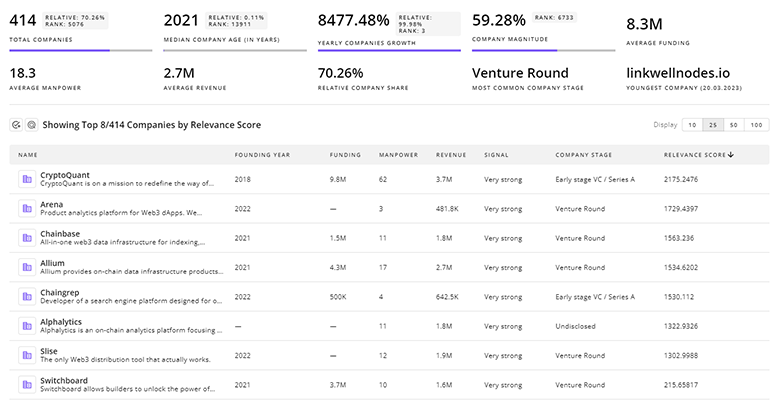
2.5K Immersive Learning Companies
Discover Immersive Learning Companies, their Funding, Manpower, Revenues, Stages, and much more
Immersive Learning Investors
The TrendFeedr’s investors tool features data on 1.7K investors and funding activities within Immersive Learning. This tool makes it easier to analyze complex investment patterns and assess market potential with thorough and up-to-date financial insights.
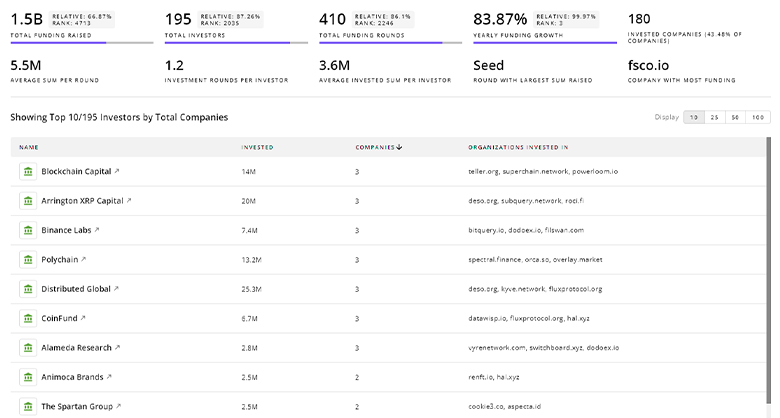
1.7K Immersive Learning Investors
Discover Immersive Learning Investors, Funding Rounds, Invested Amounts, and Funding Growth
Immersive Learning News
Stay ahead of the curve with Trendfeedr’s News feature. The tool provides access to 2.7K Immersive Learning. Navigate the current business landscape with historical and current Immersive Learning data at your fingertips.
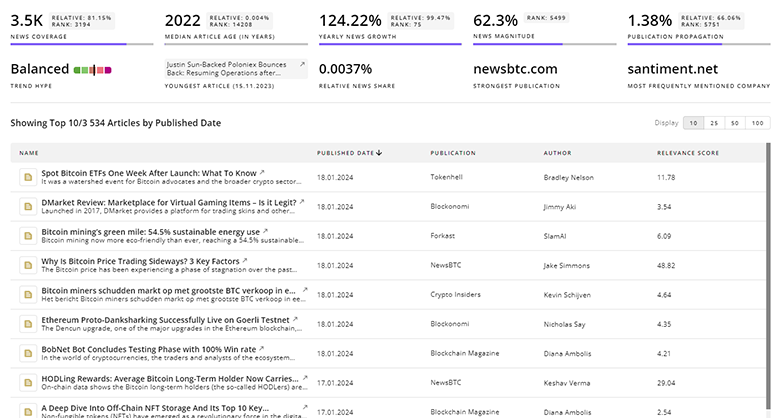
2.7K Immersive Learning News Articles
Discover Latest Immersive Learning Articles, News Magnitude, Publication Propagation, Yearly Growth, and Strongest Publications
Executive Summary
Immersive learning has moved from experimentation to practical procurement: buyers now expect measurable impact, tight LMS integrations, and content that scales without heavy studio overhead. Near term, value will come from focused use cases that map directly to cost centers—safety, clinical procedures and skilled trades—because those applications generate clear ROI through reduced incidents, faster certification and shorter time-to-competency. Strategic winners will combine three capabilities: high-fidelity simulation where it matters, AI pipelines that reduce content cost and increase personalization, and analytics that translate simulation behaviours into business KPIs. Geographic strategy matters: North America remains the revenue leader while APAC offers faster growth and opportunity for localized deployments. For corporate buyers and investors, prioritize vendors that demonstrate measured learning outcomes, have low-code authoring to scale content, and provide cloud delivery to minimize device friction.
If you’re an expert in trends or emerging tech, we invite you to contribute to our insights.