
Personalization Report
: Analysis on the Market, Trends, and TechnologiesThe personalization market is already a major commercial vector: current market analysis places its size at $2,900,000,000 with an expected CAGR of 20.8%, signaling sustained investment and adoption pressure across industries. Companies are increasing personalization budgets and moving from static segmentation to live, predictive models—yet customer trust and cookieless constraints create a simultaneous governance challenge, leaving a gap that predictive AI and privacy-first architectures can close if deployed with measurable business metrics Personalizing brand experiences.
The last time we updated this report was 219 days ago. If there’s something missing or off, your tips are welcome!
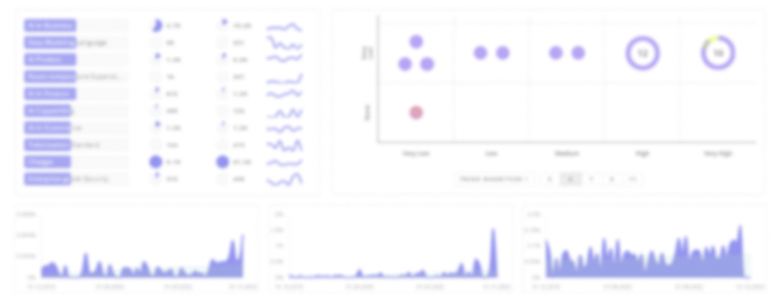
Topic Dominance Index of Personalization
The Dominance Index for Personalization merges timelines of published articles, newly founded companies, and global search data to provide a comprehensive perspective into the topic.
Key Activities and Applications
- Real-time recommendation engines for product and content flows, driven by session signals and unified profiles; these systems are central to e-commerce conversion and AOV uplift.
- Predictive next-best-action models that forecast intent and sequence offers across channels; this capability remains underused yet highly accretive when tied to acquisition and retention KPIs
- Privacy-first data collection and consent surfaces (zero-party data widgets, on-device scoring) that reframe the customer exchange and replace deprecated third-party cookie flows.
- Dynamic creative and personalized video that assembles individualized scenes, voice, and data overlays in campaign flows to lift engagement and completion rates Vintom.
- Phygital configuration and mass customization linking online configurators to automated manufacturing and fulfillment for one-off physical products (apparel, home, gifts) The Customization Group.
Emergent Trends and Core Insights
- Predictive personalization adoption gap. Only a minority of brands use predictive, AI-driven personalization, pointing to a rapid growth runway for vendors that convert model outputs into measurable reductions in acquisition costs and higher lifetime value
- Privacy as product design constraint. The shift to first-party and zero-party data is not optional; firms that design consented, transparent value exchanges scale personalization while reducing regulatory friction Marketing personalization worldwide – statistics & facts.
- Platform consolidation pressures. Market dynamics favor unified data and decisioning layers (CDP + real-time inference). Point solutions risk being absorbed or commoditized unless they provide unique vertical intelligence or a protocol role
- Commerce-to-clinical verticalization. High-value verticals (financial services, healthcare, education) demand domain-specific personalization that blends behavioral signals with market or clinical data, creating defensible moats for specialists Causal Foundry.
- Real-time, low-latency decision loops. Patent and industry signals show the technical push toward sub-second personalization cycles; firms must invest in streaming pipelines and model-ops to avoid stale relevance.
Technologies and Methodologies
- Customer Data Platforms (CDPs) + Real-time Inference: Unified profiles feeding live decisioning layers are the backbone for cross-channel personalization.
- Generative AI for dynamic creative: Uses templates plus model outputs to produce personalized landing pages, copy variants, and video scenes at scale Hyper-Personalization Explainer 2024
- Privacy-enhancing techniques (federated learning, on-device scoring): Enable models to learn without centralized PII, addressing both compliance and trust factors.
- Behavioral and psychographic modeling: Moving beyond demographics, psychographic layers detect taste and preferences to predict desire signals across contexts
- Computer vision and multimodal signals: Visual search, fit estimation, and in-store recognition feed richer signals into cross-channel personalization, especially for retail and apparel Exploding Topics - Personalization Trends.
Personalization now requires both technical depth (real-time inference, model ops) and data governance (consented, auditable inputs) to deliver reliable business outcomes.
Personalization Funding
A total of 28.9K Personalization companies have received funding.
Overall, Personalization companies have raised $628.1B.
Companies within the Personalization domain have secured capital from 80.7K funding rounds.
The chart shows the funding trendline of Personalization companies over the last 5 years
Personalization Companies
- PSYKHE AI — PSYKHE AI offers a psychographic OS that computes persistent taste profiles from live signals and powers cross-context recommendations for CPG, fashion, and beauty. The platform focuses on predicting preference before explicit search, enabling retailers to present higher-relevance assortments and reduce returns. Funding and revenue signals show early traction and a specialist moat in psychographic models.
- PersonaFin — PersonaFin applies hyper-personalization specifically to financial services by unifying content, behavior, and market data into low-code activation flows for advisory and trading experiences. Its product addresses the unique data and regulatory constraints of finance, enabling contextual nudges and tailored educational content for investors. This vertical focus creates defensibility where generic CDPs struggle.
- Tailor AI — Tailor AI generates hundreds of adaptive landing experiences that map campaign intent to page content, improving conversion by matching creative to audience signals in real time. The platform reduces dev dependency through no-code integrations and uses continuous optimization to refine variants against conversion metrics. This operationalized creative layer answers the common gap between targeted ads and generic landing pages.
- Licorice — Licorice takes a privacy-first stance by collecting preference data through explicit, anonymous question flows and returning value to publishers and marketers without invasive tracking. Its approach reframes personalization as data that is personalized, not personal, which improves consent rates and the quality of signals feeding models. That tradeoff—explicit user input for higher signal fidelity—reduces regulatory exposure and improves consumer trust.
- Solarplexus.ai — Solarplexus.ai targets large-scale marketing communication individualization using generative AI while emphasizing GDPR and EU AI Act alignment. The company focuses on creating brand-aligned, individualized messaging across enterprise campaigns, balancing scale with compliance demands in EU markets. Its small team and seed positioning make it an attractive partner for brands needing localized, lawful personalization.
Delve into the corporate landscape of Personalization with TrendFeedr’s Companies tool
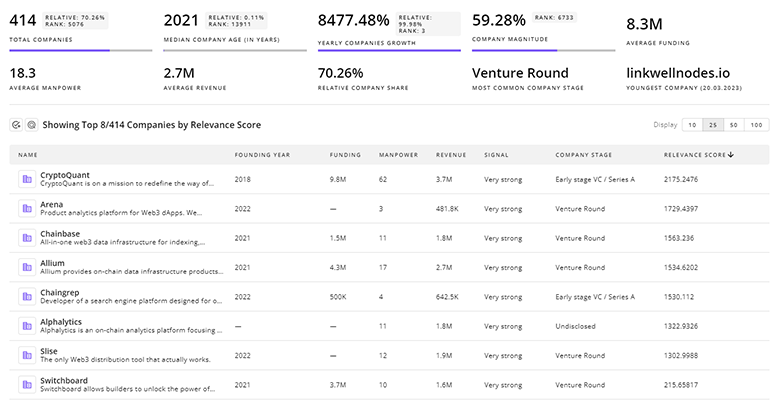
414.1K Personalization Companies
Discover Personalization Companies, their Funding, Manpower, Revenues, Stages, and much more
Personalization Investors
TrendFeedr’s Investors tool provides insights into 49.6K Personalization investors for you to keep ahead of the curve. This resource is critical for analyzing investment activities, funding trends, and market potential within the Personalization industry.
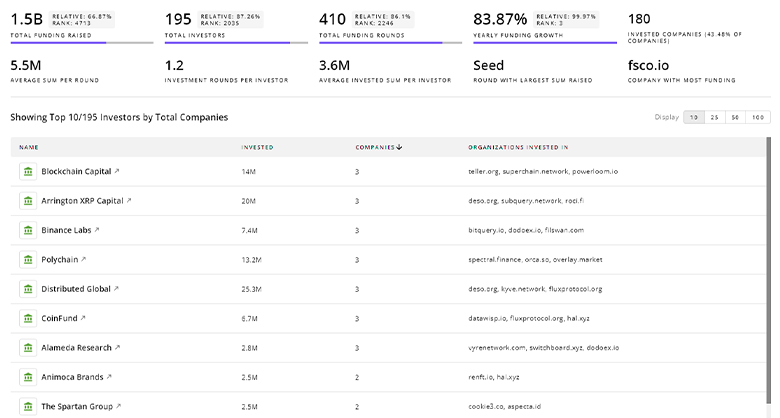
49.6K Personalization Investors
Discover Personalization Investors, Funding Rounds, Invested Amounts, and Funding Growth
Personalization News
TrendFeedr’s News feature offers you access to 18.5K articles on Personalization. Stay informed about the latest trends, technologies, and market shifts to enhance your strategic planning and decision-making.
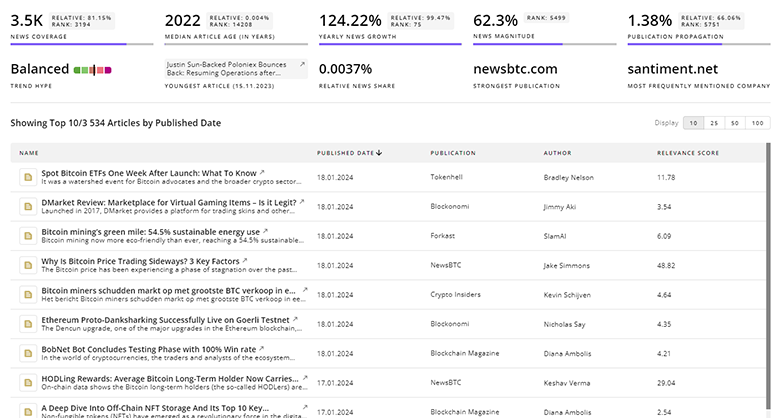
18.5K Personalization News Articles
Discover Latest Personalization Articles, News Magnitude, Publication Propagation, Yearly Growth, and Strongest Publications
Executive Summary
Personalization is now a capitalized strategic capability with measurable ROI where it is operationalized: the technical winners will be those who pair low-latency decisioning and generative content with consented, high-fidelity data inputs. Firms should prioritize investments that (1) convert model outputs into specific commercial metrics, (2) embed privacy-preserving data collection into the customer value exchange, and (3) secure vertical expertise or protocol positions that protect against commoditization. Companies that treat personalization as an integrated infrastructure problem—rather than a set of point features—will capture disproportionate value as the market consolidates.
Are you an insider in the trends or tech industry? We’d love for you to contribute to our content.