Photonics Report
: Analysis on the Market, Trends, and TechnologiesThe photonics market sits at a pivotal industrial inflection, with USD 1,750,000,000,000 in aggregate revenue projected for 2025, supported by a 6.5% market CAGR signal for the mid-decade window; this combination of scale and sustained growth points to commercialization across both integrated platform supply chains and high-value, physics-intensive niches. The next five years will separate companies that can industrialize wafer-to-module workflows and packaging from those that capture premium margins by supplying specialized quantum and ultrafast components, while data-center optical interconnects and photonic sensing remain the immediate demand engines
The last time we updated this report was 195 days ago. If there’s something missing or off, your tips are welcome!
Topic Dominance Index of Photonics
The Dominance Index for Photonics merges timelines of published articles, newly founded companies, and global search data to provide a comprehensive perspective into the topic.
Key Activities and Applications
- High-speed optical interconnects for AI/HPC and data centers — Replacing copper with photonic links to reduce rack/board power and latency remains the top commercial driver; silicon photonics and co-packaged optics are the dominant implementation pathways.
- Integrated photonic sensing (LiDAR, biomedical, environmental) — Compact PIC-based LiDAR and on-chip spectrometers enable vehicle navigation and point-of-care diagnostics, creating large, recurring hardware and software opportunities.
- Quantum photonics (QKD, quantum processors, single-photon devices) — Chip-scale single-photon sources, superconducting detectors, and photonic quantum processors move from lab prototypes into pilot deployments, opening near-term procurement by defense and telecom operators.
- Ultrafast and high-power laser manufacturing — Femtosecond and OPCPA laser systems continue to expand applications in precision micromachining and metrology for semiconductor and advanced materials industries.
- Foundry, PDK, and packaging services for PICs — Process Design Kits, wafer runs, automated die-level testing and module assembly form the critical commercialization chain for scaling PIC adoption.
Emergent Trends and Core Insights
- Integration and platform consolidation are accelerating. Foundries, PDK providers, and assembly specialists are gaining strategic control over supply chains; platform access increasingly functions as a gating factor for designers and systems integrators The Global Silicon Photonics Market 2025-2035.
- Energy efficiency is a primary procurement metric for hyperscalers. Solutions that demonstrably cut link or system power (tens of percent) earn rapid deployment priority regardless of chip economics.
- Heterogeneous integration of III-V lasers, silicon nitride and TFLN is the dominant technical route. Hybrid bonding, flip-chip, and wafer-scale integration reduce footprint while aiming to preserve yield and thermal control.
- Quantum photonics is commercializing along two vectors: telecom-compatible QKD and detector/quantum-sensor components for industry and defense; both create non-correlated revenue streams outside classical telecom cycles.
- Packaging and test remain the choke point for scale. Automated alignment, fiber-to-chip coupling and high-yield module assembly define the difference between pilot projects and high-volume rollouts.
Key operative conclusion: superior access to standardized PIC foundry flows plus vertically integrated packaging capability produces the largest asymmetric advantage in the near term.
Technologies and Methodologies
- Photonic Integrated Circuits (PICs) on SOI and SiN — The practical backbone for high-density optical routing, enabling compact transceivers, LiDAR sensors and on-chip spectroscopy; PDKs and foundries accelerate time-to-market.
- Thin-Film Lithium Niobate (TFLN) modulators — High-bandwidth, low-voltage modulators that challenge silicon modulators for RF and microwave photonics applications.
- Superconducting Nanowire Single-Photon Detectors (SNSPDs) — Integrated SNSPDs on waveguides provide the sensitivity and timing needed for quantum communication and advanced LiDAR; they form the core of several quantum product roadmaps.
- Plasmonic electro-optic modulators — Ultra-compact, ultra-fast modulators enabling extremely dense routing where silicon reach limits impose penalties; suitable for specialized test and AI interconnect subsystems.
- Femtosecond lasers and frequency combs — Critical for precision metrology, spectroscopy and next-gen manufacturing processes Class 5 Photonics.
- Automated photonic probe, alignment and wafer-scale test — Automated die-level optical testing and active alignment drastically reduce per-module costs and are prerequisites for volume PIC adoption PHIX.
Photonics Funding
A total of 918 Photonics companies have received funding.
Overall, Photonics companies have raised $65.4B.
Companies within the Photonics domain have secured capital from 3.6K funding rounds.
The chart shows the funding trendline of Photonics companies over the last 5 years
Photonics Companies
- SCINTIL Photonics — SCINTIL Photonics is a fabless silicon-photonics company focused on integrating active laser sources onto silicon PICs to serve AI data-center interconnects; the firm has raised €140.62M and targets low-latency, energy-efficient transceiver modules that reduce system OPEX for hyperscalers. Their SHIP™ heterogeneous process addresses the active-integration hurdle many foundries face, positioning them as a near-term supplier to hyperscale networking OEMs.
- Pixel Photonics — Pixel Photonics builds integrated SNSPDs on nanophotonic waveguides to deliver near-unity detection efficiency for quantum communication and high-resolution LiDAR$8.73M raised) and a product roadmap aimed at instrument vendors and quantum system integrators.
- Polariton Technologies Ltd. — Polariton Technologies develops plasmonic electro-optic modulators that demonstrate extremely high speed (lab records to 500 GHz) and ultra-compact footprints; their devices target ultra-dense interconnects and specialized test & measurement applications where density and latency dominate the procurement tradeoffs.
- NewPhotonics — NewPhotonics engineers PICs and optical signal-processing engines for pluggable and co-packaged optics aimed specifically at AI scale data centers; the company has raised $86M and pursues power reduction and integrated equalization approaches that reduce system thermal load and module complexity.
- PhotonPath — PhotonPath is a PIC design-and-product company spun out of academic research focused on programmable, low-loss circuits for harsh environments and telecom; PhotonPath offers an integrated API and manufacturable PDK flows intended to accelerate operator trials and regional deployments.
(Note: company details above draw from company profiles and market synthesis reports; each company citation follows the company dataset record immediately after the descriptive sentence.)
Delve into the corporate landscape of Photonics with TrendFeedr’s Companies tool
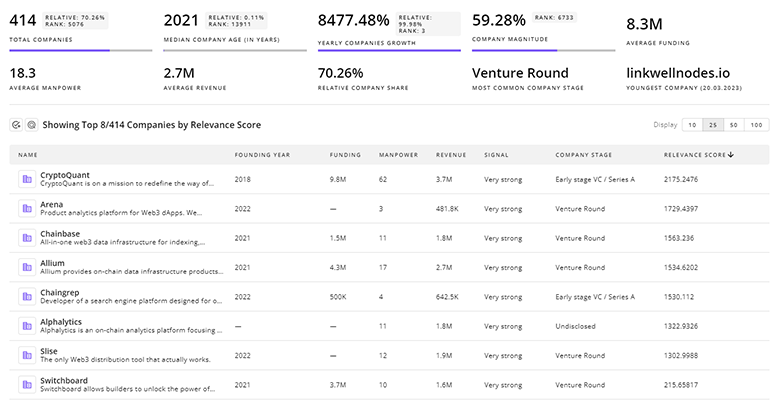
4.4K Photonics Companies
Discover Photonics Companies, their Funding, Manpower, Revenues, Stages, and much more
Photonics Investors
TrendFeedr’s Investors tool provides insights into 3.5K Photonics investors for you to keep ahead of the curve. This resource is critical for analyzing investment activities, funding trends, and market potential within the Photonics industry.
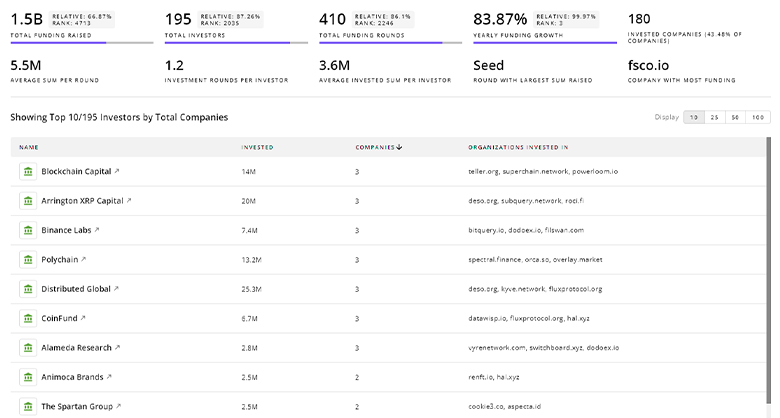
3.5K Photonics Investors
Discover Photonics Investors, Funding Rounds, Invested Amounts, and Funding Growth
Photonics News
TrendFeedr’s News feature offers you access to 20.7K articles on Photonics. Stay informed about the latest trends, technologies, and market shifts to enhance your strategic planning and decision-making.
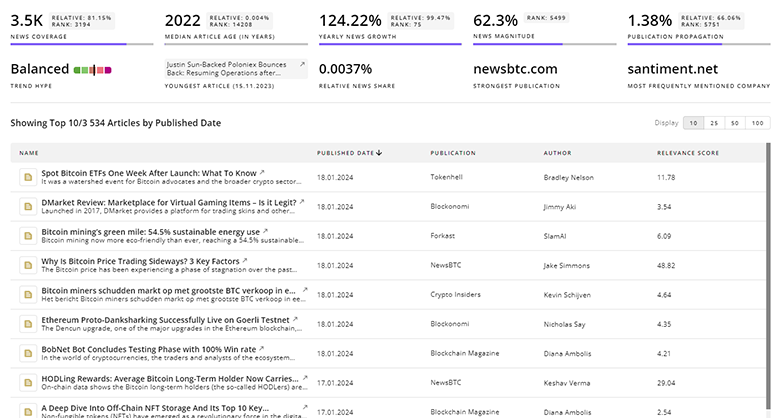
20.7K Photonics News Articles
Discover Latest Photonics Articles, News Magnitude, Publication Propagation, Yearly Growth, and Strongest Publications
Executive Summary
The photonics industry bifurcates into platform providers that deliver predictable, scalable PIC manufacturing and assembly, and physics-centric specialists that sell high-margin components for quantum, sensing and ultrafast applications. The business imperative is clear: secure foundry and packaging access or own a physics advantage that resists commoditization. Data-center optical interconnects and integrated sensing unlock the largest near-term revenue pools; quantum photonics and plasmonic modulators create differentiated, defensible positions that command premium pricing. Investors and corporate strategists should prioritize durable access to PDKs, wafer flows and automated module assembly while selectively backing niche physics plays that solve energy or sensitivity limits electronics cannot address.
Are you an insider in the trends or tech industry? We’d love for you to contribute to our content.