Supply Chain Intelligence Report
: Analysis on the Market, Trends, and TechnologiesThe supply chain intelligence market is shifting from visibility tools to embedded, prescriptive AI that executes decisions: platforms that translate insight into transaction-level action capture disproportionate value. Market signals show 956 active companies, $19.02B total funding across the field and $14.88B total annual revenue—metrics that imply available scale for platform consolidation and rapid productization of agentic capabilities.
303 days ago, we last updated this report. Notice something that’s not right? Let’s fix it together.
Topic Dominance Index of Supply Chain Intelligence
To gauge the influence of Supply Chain Intelligence within the technological landscape, the Dominance Index analyzes trends from published articles, newly established companies, and global search activity
Key Activities and Applications
- Real-time risk monitoring and verification — Continuous ingestion of crime, climate and geopolitical feeds into supplier trust scores to convert raw events into procurement actions.
- Predictive demand forecasting and inventory automation — SKU-level forecasting that directly triggers purchase orders and replenishment, reducing manual PO cycles and improving cash flow.
- AI-driven procurement and supplier automation — Automated supplier outreach, quote aggregation, and negotiation workflows that compress sourcing timelines and reduce acquisition cost.
- Digital twin scenario modeling for orchestration — End-to-end network simulations used for contingency planning (port closures, energy shocks) that feed prescriptive changes into execution systems.
- Sustainability and compliance analytics — Integrated carbon and ESG metrics placed alongside cost/service trade-offs to support regulatory reporting and investor decisioning.
- Edge-enabled sensing and condition monitoring — IoT and edge compute at ports, warehouses and vehicles enabling sub-second alerts and localized corrective actions.
Emergent Trends and Core Insights
- Agentic AI that acts, not only advises — Systems move from recommending (what to order) to executing (placing orders, reassigning carriers), compressing decision latency and realizing measurable savings.
- Connected Intelligence across enterprise domains — Supply chain data integrates with finance, ESG and CRM to enable finance-grade trade-offs and investor-auditable sustainability claims.
- Visibility to orchestration pathway — Visibility platforms evolve into control towers and execution layers that close the loop between detection and remediation Charting the Journey from Point Control Towers to True Supply Chain Orchestration.
- Verticalized intelligence yields higher ROI — Domain-specific models (healthcare, CPG, industrial) outperform horizontal approaches on accuracy and adoption speed because they embed domain constraints and specialized signals.
- Data harmonization becomes the primary barrier — The industry’s gating problem is not model sophistication but multi-source data quality and interoperability; successful vendors provide a durable data fabric or context layer to feed AI.
- Sustainability intelligence moves from reporting to optimization — Carbon cost is operationalized into routing, inventory and sourcing decisions, making ESG metrics a lever for both compliance and margin improvement.
Technologies and Methodologies
- Digital twins with closed-loop execution — Live twins that synthesize IoT telemetry, ERP state and market signals to test actions before committing to execution.
- Generative AI and agentic workflows for procurement — Models that synthesize RFP/RFI responses, draft contracts, and operate bidding processes at scale, accelerating capture and negotiation Procurement Sciences.
- Graph analytics and supply-network mapping — Multi-tier topology analysis to surface hidden dependency clusters and quantify substitution elasticity.
- IoT + Edge compute for latency-sensitive alerts — Edge processing of sensor streams to push sub-second operational corrections in warehouses and during transport.
- Federated data architectures and data fabrics — Secure, privacy-preserving federations that allow partner data usage without wholesale centralization, addressing legal and commercial constraints.
- Reinforcement learning for autonomous optimization — Emerging patent activity indicates movement toward RL agents that not only predict but take actions to optimize multi-objective KPIs such as cost, service, and emissions.
Supply Chain Intelligence Funding
A total of 238 Supply Chain Intelligence companies have received funding.
Overall, Supply Chain Intelligence companies have raised $19.0B.
Companies within the Supply Chain Intelligence domain have secured capital from 874 funding rounds.
The chart shows the funding trendline of Supply Chain Intelligence companies over the last 5 years
Supply Chain Intelligence Companies
- Synth — Synth centralizes inventory into a single, revenue-aware planning platform and advertises an operational model where a small team runs large CPG operations using AI teammates called RevChain. The company emphasizes cash-flow improvement through automated purchase order planning and lightweight headcount, supporting rapid scaling for consumer brands.
- Crest — Crest is an AI-driven inventory planning tool for SMB and D2C brands; customers report 50% fewer stock-outs and a 15% increase in top-line revenue within months of deployment, indicating strong near-term ROI for automated replenishment and demand sensing.
- SIMCEL — SIMCEL packages a digital-twin IBP solution for executive planning, enabling KPI-side-by-side carbon impact modeling and profitability trade-offs for scenario analysis; it targets C-suite decision cycles and integrated decarbonization planning.
- Clearpepper — Clearpepper combines digital twins, graph databases and AI to produce an intelligence fabric for decisioning and anomaly detection; its light enterprise footprint suits teams moving from point tools to unified simulation.
- pacemaker.ai — pacemaker.ai (thyssenkrupp) offers cloud AI optimization that explicitly embeds CO2 accounting into supply-chain decision models, aligning industrial procurement optimization with sustainability constraints and compliance workflows.
The following table compares the five companies above across funding/scale and primary focus. Each row cites the company record source inside the row.
Get detailed analytics and profiles on 956 companies driving change in Supply Chain Intelligence, enabling you to make informed strategic decisions.
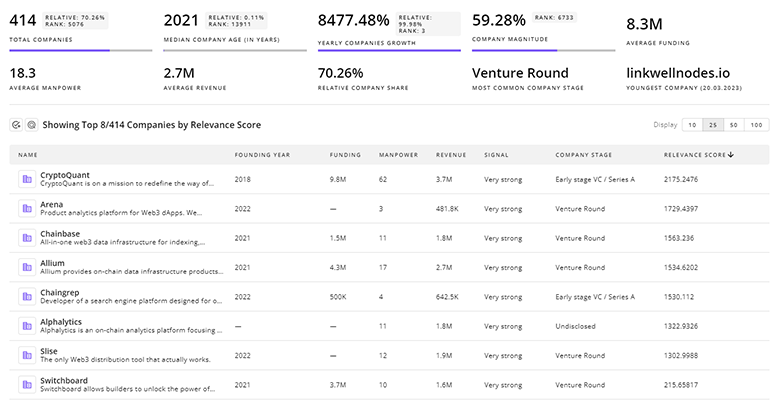
956 Supply Chain Intelligence Companies
Discover Supply Chain Intelligence Companies, their Funding, Manpower, Revenues, Stages, and much more
Supply Chain Intelligence Investors
TrendFeedr’s Investors tool provides an extensive overview of 1.2K Supply Chain Intelligence investors and their activities. By analyzing funding rounds and market trends, this tool equips you with the knowledge to make strategic investment decisions in the Supply Chain Intelligence sector.
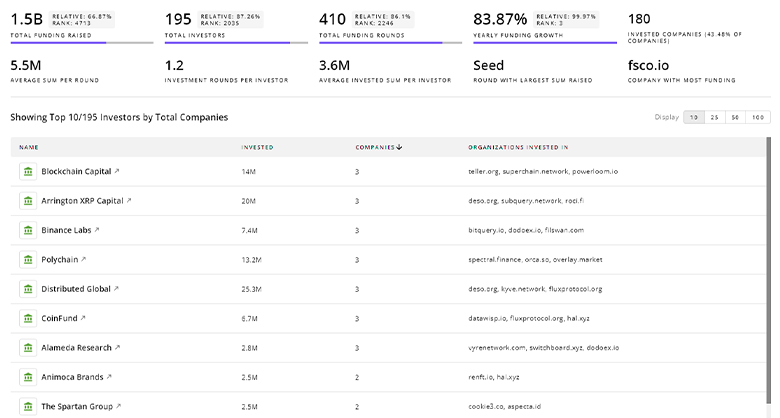
1.2K Supply Chain Intelligence Investors
Discover Supply Chain Intelligence Investors, Funding Rounds, Invested Amounts, and Funding Growth
Supply Chain Intelligence News
Explore the evolution and current state of Supply Chain Intelligence with TrendFeedr’s News feature. Access 1.9K Supply Chain Intelligence articles that provide comprehensive insights into market trends and technological advancements.
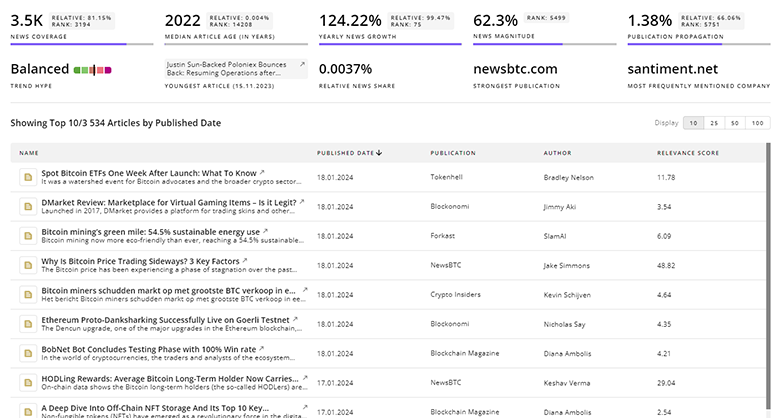
1.9K Supply Chain Intelligence News Articles
Discover Latest Supply Chain Intelligence Articles, News Magnitude, Publication Propagation, Yearly Growth, and Strongest Publications
Executive Summary
Supply chain intelligence has entered a phase where execution matters as much as insight. The most valuable investments convert real-time detection and probabilistic forecasts into deterministic actions that change inventory, procurement and routing behavior. Data harmonization, verticalized models and sustainability-aware optimization represent the three practical axes where companies can capture measurable operational and financial improvement. Firms that align their roadmaps to integrate AI agents into transactional systems, while protecting data integrity and domain signal quality, will convert the current wave of funding and technology churn into durable competitive advantage.
We're looking to collaborate with knowledgeable insiders to enhance our analysis of trends and tech. Join us!