Tidal Energy Report
: Analysis on the Market, Trends, and TechnologiesThe tidal-energy sector is entering an accelerated commercial phase anchored by demonstrable market growth and concentrated public investment: the market was $1,200,000,000 in 2023 with a projected CAGR of 21.9% and a forecast value of $8,600,000,000 by 2033, signaling a financing and deployment window for projects that move beyond pilots to array-scale revenue models. Recent market reports reinforce strong multi-year upside and multiple scenario projections for multi-billion valuations, driven by tidal-stream deployments, hybrid projects and policy-backed procurement mechanisms Tidal Energy Market Size, Share and Growth Report, 2033.
245 days ago, we last updated this report. Notice something that’s not right? Let’s fix it together.
Topic Dominance Index of Tidal Energy
To gauge the influence of Tidal Energy within the technological landscape, the Dominance Index analyzes trends from published articles, newly established companies, and global search activity
Key Activities and Applications
- Grid-scale power generation — Deployment of tidal-stream arrays and tidal-range installations to supply predictable baseload electricity to coastal grids; major demonstration farms (e.g. multi-MW arrays) are the critical next step for price discovery and bankable LCoE trajectories.
- Desalination co-locates — Using tidal electricity to drive reverse-osmosis and other desalination processes in island and coastal communities reduces diesel dependence and creates an early commercial use case with measurable revenue stacking Wave And Tidal Energy Market (2024 - 2030).
- Energy-vector integration (hydrogen + storage) — Tidal arrays paired with electrolyzers and battery systems to produce green hydrogen or firmed power for industry, improving revenue certainty beyond merchant power sales Tidal Power - Market Share Analysis, Industry Trends & Statistics, Growth Forecasts (2025 - 2030).
- Coastal resilience and multi-purpose infrastructure — Tidal barrages and lagoons evaluated as combined energy + coastal protection assets, which enables access to alternate funding streams (resilience budgets, blue-carbon credits).
- Remote and microgrid replacement of diesel — Small to modular hydrokinetic units and river/estuary deployments displace diesel generators in islands and remote communities, creating lower-risk pathways to commercial scale and local acceptance ORPC.
"Priority commercial traction will come where tidal generation can be sold into firm demand (desalination, hydrogen, or local microgrids) rather than competing head-to-head with heavily subsidized large-scale wind." — synthesis of market and project data.
Emergent Trends and Core Insights
- Tidal-stream concentration of value — Tidal-stream devices account for the lion's share of current commercial revenue activity and pipeline projects because of higher capacity factors and grid predictability; many forecasts show tidal-stream revenue dominance through the 2020s.
- Standardization pressure around floating platforms — Floating, surface-moored turbines reduce installation and O&M risk versus seabed-fixed units and are rapidly moving into multi-MW demonstrators and OEM supply-chain agreements Orbital Marine Power Ltd.
- Array-level intelligence and performance management — Operators are prioritizing digital twins, AI performance optimization and predictive maintenance to lower O&M and increase availability across tidal cycles Wave & Tidal Energy Market Size, 2026-2035 Trends Report.
- Hybrid revenue stacking as de-risking strategy — Projects that combine tidal generation with hydrogen production, desalination, storage or coastal services secure diversified cash flows and shorter paths to bankability.
- Policy and procurement shaping scale timing — Targeted CfD lanes, national innovation grants and DOE programs materially change project economics and lender appetite; jurisdictions with clear procurement (UK, South Korea, parts of China, and US pilot funding) attract the earliest commercial capacity growth.
- Environmental evidence now enabling faster permitting — Multi-year monitoring from operating arrays (river and coastal) is reducing uncertainty on wildlife interactions, which shortens permitting timelines for follow-on projects in many jurisdictions.
Technologies and Methodologies
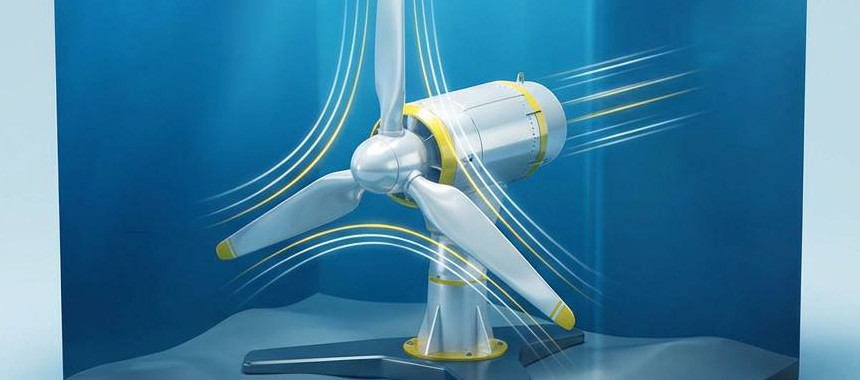
- Horizontal-axis tidal turbines — The dominant, mature topology used in most arrays; continued incremental improvements on blades, composite materials and PTOs drive incremental LCoE reductions.
- Floating tidal platforms — Modular, surface-moored systems that enable easier maintenance, reduced seabed work and scalability across deeper sites.
- Tidal kites and subsea kinematic systems — Tidal kites widen the resource envelope by efficiently harvesting lower-speed currents and enabling access to deep or distributed sites.
- Integrated PTOs and linear generators — Low-complexity, direct-drive or linear PTO architectures reduce mechanical failure points and simplify grid interface for hybrid converters.
- Array control, digital twins and AI performance optimization — Active control strategies and predictive maintenance reduce downtime and extend mean time between interventions for submerged assets.
- Multi-vector projects (hydrogen, desalination, storage) — Practical deployments of electrolyzers and desalination units co-located with tidal plants create higher net present value per site and accelerate commercial acceptance.
Tidal Energy Funding
A total of 73 Tidal Energy companies have received funding.
Overall, Tidal Energy companies have raised $2.7B.
Companies within the Tidal Energy domain have secured capital from 279 funding rounds.
The chart shows the funding trendline of Tidal Energy companies over the last 5 years
Tidal Energy Companies
- Waterotor Energy Technologies, Inc. — Waterotor designs a hydrokinetic device optimized for very low-speed flows (operational down to 0.8 m/s), targeting riverine and slow coastal currents where conventional turbines underperform. The device's low-maintenance profile positions it for diesel-replacement projects in remote communities and for municipal water system energy harvesting. The company's compact footprint and demonstrated efficiency create a practical entry route into early commercial contracts.
- SeaQurrent® — SeaQurrent® develops the TidalKite™ System, designed to produce continuous baseload energy by flying a wing-type device through tidal currents; this unlocks sites with strong currents at depth and improves energy density per mooring. The company positions the technology as a 24/7 supply for industry and data centers in coastal regions and is actively scaling development after a EUR funding round. SeaQurrent emphasizes rapid retrieval and low-impact mooring to ease permitting and O&M.
- Oceantera — Oceantera focuses on project development and hybrid system integration for Southeast Asia, coupling tidal demonstrations with desalination and local grid services to replace diesel in island communities. The joint venture structure combines regional market intelligence with technical partners to accelerate deployments in Indonesia and Singapore. Its commercial approach emphasizes local partnerships and staged expansion to reduce execution risk.
- Trident Energy — Trident Energy commercializes a patented direct-drive linear generator that simplifies power take-off across wave and tidal devices, enabling modular integration into multiple converter types. By offering a generalized, low-parts PTO, the company reduces customization cost and shortens the hardware supply chain for designers and integrators. This horizontal approach to PTOs targets the standardization needs of the sector.
- Tidal Energy Corp — Tidal Energy Corp pursues a large-scale project strategy focused on 1.21 GW Turnagain Arm in Cook Inlet, where tidal power pairs with green hydrogen production to create merchant-grade offtake options. The company's hydrogen integration approach demonstrates a pathway to monetise high-capacity projects by selling industrial hydrogen and firmed power rather than relying solely on merchant electricity markets. Their model exemplifies how tidal projects can align with national hydrogen strategies to secure long-term revenue.
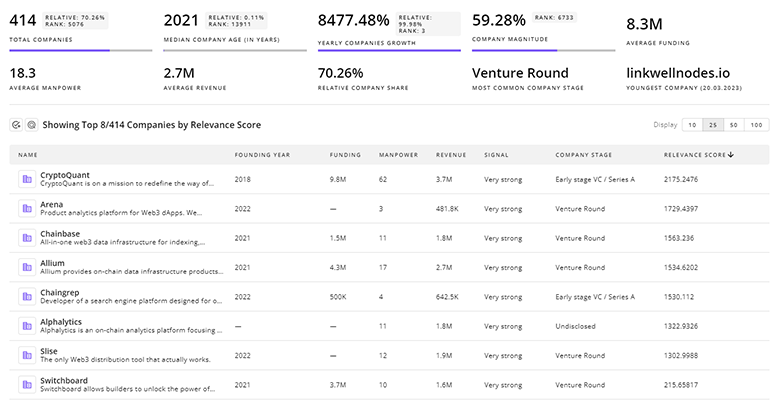
Get detailed analytics and profiles on 381 companies driving change in Tidal Energy, enabling you to make informed strategic decisions.
381 Tidal Energy Companies
Discover Tidal Energy Companies, their Funding, Manpower, Revenues, Stages, and much more
Tidal Energy Investors
TrendFeedr’s Investors tool provides an extensive overview of 213 Tidal Energy investors and their activities. By analyzing funding rounds and market trends, this tool equips you with the knowledge to make strategic investment decisions in the Tidal Energy sector.
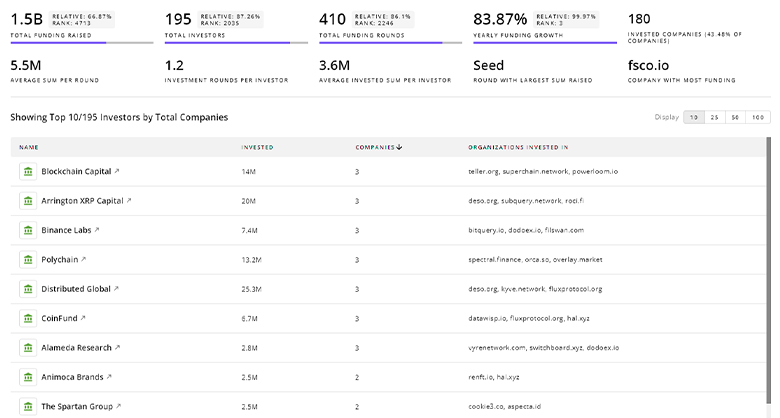
213 Tidal Energy Investors
Discover Tidal Energy Investors, Funding Rounds, Invested Amounts, and Funding Growth
Tidal Energy News
Explore the evolution and current state of Tidal Energy with TrendFeedr’s News feature. Access 2.4K Tidal Energy articles that provide comprehensive insights into market trends and technological advancements.
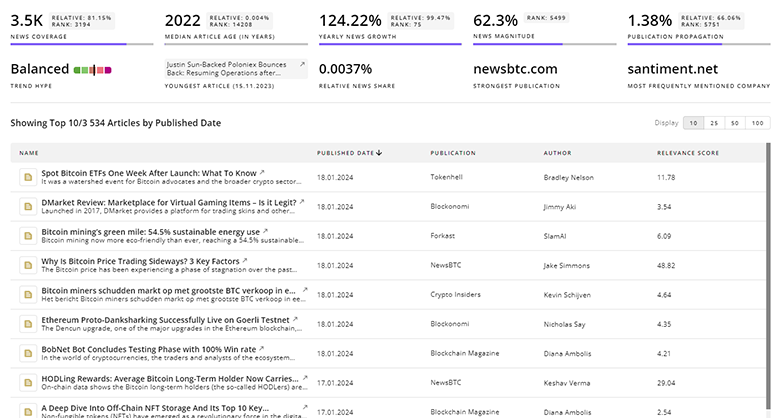
2.4K Tidal Energy News Articles
Discover Latest Tidal Energy Articles, News Magnitude, Publication Propagation, Yearly Growth, and Strongest Publications
Executive Summary
Tidal energy now sits at a practical inflection: validated pilot projects, concentrated public procurement, and improving technology cost curves create a credible path to commercial arrays if developers combine predictable tidal output with non-power revenue streams. The most investable opportunities in the next five years are those that (1) secure long-term offtake or service revenues (desalination, hydrogen, resilience contracts), (2) adopt floating, modular architectures to cut installation and O&M risk, and (3) implement digital control and storage to present dispatchable value to grid operators. For investors and utilities, the priority is to back platform standardization and hybrid use cases that shorten payback horizons while developers must prioritize environmental monitoring and local stakeholder alignment to accelerate permitting and unlock large-scale deployment.
We're looking to collaborate with knowledgeable insiders to enhance our analysis of trends and tech. Join us!