Diagnostic Imaging Report
: Analysis on the Market, Trends, and TechnologiesThe diagnostic imaging market shows sustained expansion driven by demand for quantitative outputs and networked workflows, with the core topic reporting a 2024 market size of $33,700,000,000 and a CAGR of 5.1%. External market analyses point to substantially larger services markets (U.S. projections indicate $140.21 billion in 2024, rising toward $239.74 billion by 2032, at an implied 7.0% CAGR) Fortune Business Insights – U.S. Diagnostic Imaging Services Market Size & Growth and global services forecasts in the mid-hundreds of billions. Investment and patent activity concentrate on making images quantitative, interoperable, and self-explanatory (AI reconstruction, spectral and multimodal fusion, motion compensation). Service providers that combine low-cost, outpatient/mobile deployment with vendor-agnostic, AI-first workflow layers will capture disproportionate value as payors and health systems push toward outcome-linked imaging utilization.
We updated this report 56 days ago. Noticed something’s off? Let’s make it right together — reach out!
Topic Dominance Index of Diagnostic Imaging
The Topic Dominance Index trendline combines the share of voice distributions of Diagnostic Imaging from 3 data sources: published articles, founded companies, and global search
Key Activities and Applications
- Cardiac function assessment and vascular imaging — high-volume use of CT angiography and functional MRI protocols to stratify risk and triage invasive procedures.
- Oncology staging and therapy monitoring — PET/CT, PET/MRI and advanced radiomics pipelines for lesion characterization and response assessment; imaging is increasingly embedded in clinical trials and drug development workflows.
- Point-of-care and mobile imaging — bedside portable X-ray, handheld ultrasound, and mobile MRI/CT units deployed to nursing homes, rural communities, and high-demand clinics to reduce transfers and readmissions.
- Interventional guidance and therapy integration — real-time cone-beam CT and high-resolution fluoroscopy guiding minimally invasive procedures, enabling image-guided ablation and embolization.
- Screening and preventive programs — low-dose CT for lung cancer screening and 3D mammography / contrast methods for breast screening; mobile mammography units extend access for population screening.
- Teleradiology and centralized reporting — 24/7 remote interpretation and subspecialty reads decouple interpretation capacity from acquisition geography, raising throughput and enabling night/day work distribution.
Emergent Trends and Core Insights
- AI-first workflow orchestration — AI moves from point algorithms to platform layers that automate triage, pre-annotations, standardized measurements, and structured reports, shrinking turnaround and reducing repetitive work.
- From images to quantitative biomarkers — emphasis now sits on producing reproducible, vendor-agnostic numerical outputs (perfusion maps, blood-flow indices, standardized texture metrics) to support outcome-based pathways and trials.
- Dose-efficient imaging and low-field innovation — deep-learning reconstruction and low-dose CT protocols expand scan access in constrained settings while preserving diagnostic quality.
- Portable ultrasound acceleration — handheld, AI-assisted ultrasound broadens frontline screening and triage in primary care, emergency medicine, and underserved regions.
- Sustainability in operations — energy-efficient hardware and optimized scheduling lower per-scan cost and address ESG priorities; green initiatives gain attention from large payors and systems.
- Consolidation vs. specialization — national networks and rollups scale outpatient capacity and negotiate payor contracts, while niche vendors (AI, tomographic ultrasound, photo-acoustics) seek acquisition or partnership with infrastructure players.
Technologies and Methodologies
- AI-driven reconstruction and analysis — deep learning used both to reconstruct low-dose CT/MRI data and to extract standardized metrics for clinical decision support.
- Spectral and photon-counting CT — material decomposition and enhanced contrast separation add functional capability to standard CT workflows.
- 3T and advanced MRI protocols — high-field and quantitative MRI sequences (perfusion, diffusion, MR fingerprinting) for neuro and oncologic endpoints 3T MRI.
- Tomographic 3D ultrasound (vendor-independent) — retrospective volumetric review and AI analysis reduce operator dependence and enable remote reads.
- Photo-acoustic mammography and non-ionizing modalities — emerging physics for breast imaging that promise high resolution without compression or ionizing dose.
- Cloud-native PACS/RIS with AI plugins — centralized worklists, universal viewer, and modular AI services that integrate across heterogeneous acquisition devices, improving radiologist productivity.
- Augmented reality and intraoperative navigation — AR platforms supporting holographic overlays for interventional procedures, enabling remote collaboration and enhanced surgical guidance.
Diagnostic Imaging Funding
A total of 967 Diagnostic Imaging companies have received funding.
Overall, Diagnostic Imaging companies have raised $37.2B.
Companies within the Diagnostic Imaging domain have secured capital from 2.5K funding rounds.
The chart shows the funding trendline of Diagnostic Imaging companies over the last 5 years
Diagnostic Imaging Companies
- Imaginostics — A small, focused team developing a QUTE-CE MRI vascular imaging approach that claims 10× higher vascular contrast versus standard gadolinium MRI, producing quantitative microvascular biomarkers intended for neurology and oncology trials. Their commercial strategy targets drug developers and specialty centers that need validated imaging endpoints to accelerate trials and patient stratification.
- PIUR IMAGING — Builds a vendor-agnostic tomographic 3D ultrasound stack that converts standard transducers into volumetric scanners, enabling retrospective review and AI-assisted analysis for thyroid and nodal assessment; funding of $21.71M underscores traction in targeted clinical workflows.
- Synapsica — Develops an AI-first RIS/PACS layer focused on automated reporting, structured templates, and prefilled measurements for spine and chest workflows; the product strategy emphasizes rapid deployment above existing imaging stacks rather than replacing scanners, enabling fast productivity wins for high-volume centers.
- RadioEye — Niche AI search and case-matching tool for orbital and complex MRI cases that integrates into PACS and helps radiologists retrieve visually similar cases to support differential diagnosis; the offering is tailored to subspecialists who require curated comparative evidence for atypical studies.
- PA Imaging — Developing photo-acoustic mammography systems designed to provide high-resolution, non-compressive breast imaging as an alternative to X-ray mammography and MRI; the technology targets screening/diagnostic gaps in dense breast populations and aims to reduce false positives and patient discomfort.
Gain a better understanding of 7.6K companies that drive Diagnostic Imaging, how mature and well-funded these companies are.
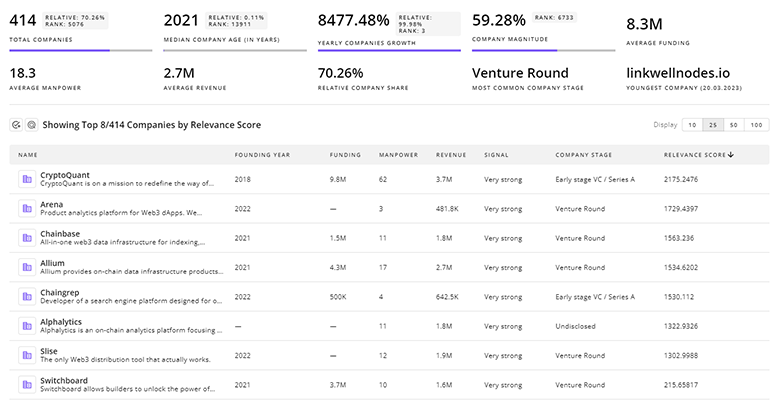
7.6K Diagnostic Imaging Companies
Discover Diagnostic Imaging Companies, their Funding, Manpower, Revenues, Stages, and much more
Diagnostic Imaging Investors
Gain insights into 2.4K Diagnostic Imaging investors and investment deals. TrendFeedr’s investors tool presents an overview of investment trends and activities, helping create better investment strategies and partnerships.
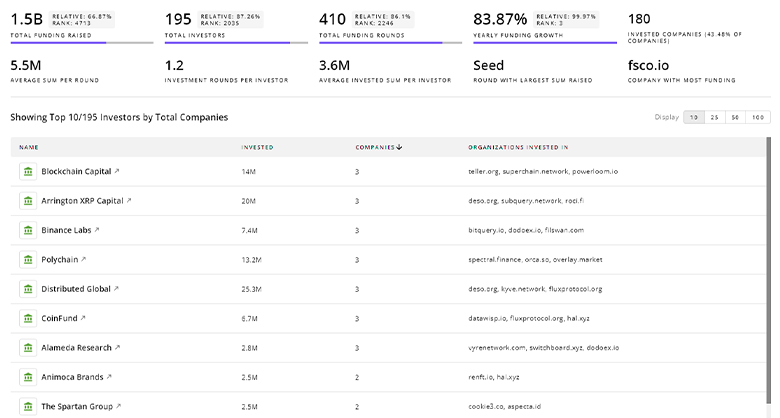
2.4K Diagnostic Imaging Investors
Discover Diagnostic Imaging Investors, Funding Rounds, Invested Amounts, and Funding Growth
Diagnostic Imaging News
Gain a competitive advantage with access to 5.1K Diagnostic Imaging articles with TrendFeedr's News feature. The tool offers an extensive database of articles covering recent trends and past events in Diagnostic Imaging. This enables innovators and market leaders to make well-informed fact-based decisions.
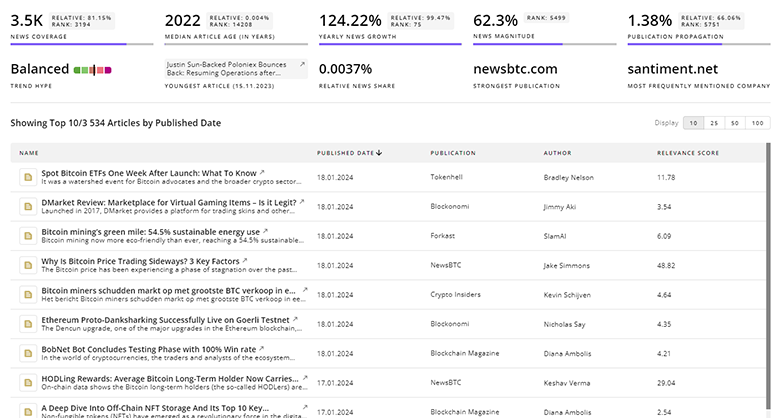
5.1K Diagnostic Imaging News Articles
Discover Latest Diagnostic Imaging Articles, News Magnitude, Publication Propagation, Yearly Growth, and Strongest Publications
Executive Summary
Diagnostic imaging is transitioning from modality-centric hardware markets to a layered ecosystem where data harmonization, validated quantitative biomarkers, and workflow orchestration determine value capture. The internal topic data shows a $33.7B market with 5.1% growth that sits alongside much larger services markets when interpreted at the healthcare-services level. Strategic winners will be those that enable interoperable, AI-backed measurement standards and couple them with flexible deployment (outpatient, mobile, cloud) that meets payor demands for cost and outcome alignment. Investing in validated, vendor-neutral software and in portable, low-dose acquisition platforms offers the most direct path to scalable adoption and measurable ROI.
We seek partnerships with industry experts to deliver actionable insights into trends and tech. Interested? Let us know!