Retail AI Report
: Analysis on the Market, Trends, and TechnologiesThe retail AI market is scaling rapidly, with a projected market size of $24.1B by 2028 and a 24.4% CAGR that underscores accelerating commercialization and adoption across physical and digital channels. Investment and patent activity show the industry shifting from isolated pilots to operational systems that tie computer vision, demand forecasting, and autonomous decisioning into closed-loop workflows, while data readiness and governance remain the primary gating factors for measurable ROI.
This report was last revised 33 days ago. See a missing piece? Your input can help — contact us.
Topic Dominance Index of Retail AI
The Dominance Index for Retail AI delivers a multidimensional view by integrating data from three key viewpoints: published articles, companies founded, and global search trends
Key Activities and Applications
- Real-time inventory and shelf monitoring. Computer-vision systems detect out-of-stock items, planogram deviations and trigger immediate restock or robotic dispatch; these applications are moving from weekly audits to continuous operational controls, cutting stockout durations materially.
- Autonomous and cashierless commerce. Camera- and sensor-driven store stacks and smart-carts convert existing infrastructure into unattended or assisted checkout experiences, improving throughput and reducing front-end labor needs Caper.
- SKU-level demand forecasting and allocation. SKU forecasts operating at hourly-to-weeks horizons reduce overstocks and markdowns; firms that combine high-frequency signals with prescriptive allocation recover margin and working-capital efficiency.
- Agentic customer assistants and conversational commerce. Proprietary LLMs and retrieval-augmented systems serve discovery, comparison and checkout flows—shifting referral share away from traditional SEO and ads toward conversational interfaces.
- Loss prevention and front-end integrity. Visual-AI that identifies scan-avoidance, push-outs and suspicious behavior converts surveillance feeds into actionable evidence for staff and legal follow-up, reducing shrink iRetailCheck.
- Retail media and audience monetization. Retailers convert shopper signals into first-party ad inventory and attribution products, increasing ad yield per customer and improving measurement of in-store ROI Footprints AI.
- Workforce orchestration and knowledge copilots. AI-driven scheduling, mobile knowledge bases and automated tasking shift associates from repetitive tasks to sales and customer service, while reducing labor cost volatility.
Emergent Trends and Core Insights
- Agentic decisioning moves from advisory to action. Organizations are deploying AI agents that not only recommend actions but execute replenishment, price changes and routing decisions with human-defined guardrails, accelerating time-to-value but increasing governance needs.
- Data unification is the competitive moat. Breadth and cleanliness of product, transaction and sensor data determine which companies can be "eligible" to appear in agentic recommendations; those who build data infrastructure as a product (DaaS) reap durable advantage.
- Edge-first inference and low-latency actuation are required for true autonomy. Use cases that require sub-second response—loss prevention, robot tasking, localized price changes—demand on-device accelerators and distributed model updates rather than cloud-only inference.
- Synthetic data and digital twins compress time-to-accuracy for vision models. Synthetic catalogs and simulated store environments enable rapid SKU onboarding and reduce field retraining cycles, improving deployment velocity for image-recognition solutions.
- SMB adoption gap persists but is narrowing via RaaS and managed offerings. Robots-as-a-Service and turnkey vision SaaS products lower capex barriers; however, smaller chains still trail larger retailers in AI maturity and data readiness.
- Governance, explainability and consumer trust are now board-level topics. As systems take operational actions, transparency about decision logic and data use becomes essential to safeguard brand trust and regulatory compliance Retail 2026 AI Adoption.
Technologies and Methodologies
- Computer vision and instance-level SKU recognition. High-accuracy, SKU-granular models power shelf audits, checkout integrity and frictionless commerce; commercial engines achieve high recall even in occluded, low-light conditions.
- Large language models plus RAG for conversational discovery. Proprietary retail LLMs integrated with secure product contexts provide chat-based discovery and conversion while minimizing hallucination risk AI Agent Trends 2026.
- Reinforcement learning for dynamic pricing and allocation. RL systems iterate on price and promotion actions against revenue and margin objectives, learning optimal policies from live traffic and transactions Artificial Intelligence (AI) in Retail Industry.
- Federated learning and privacy-preserving pipelines. To share model improvements without moving raw sensor or customer data, federated architectures and weight aggregation emerge as practical paths for multi-store rollouts.
- Spatial intelligence and 3D digital twins. Real-time 3D mapping of store geometry tied to detection systems enables navigation, heat-mapping and guided merchandising at scale AiFi Inc..
- No-code/low-code operational AI platforms. These platforms accelerate value capture by enabling retail teams to create agents, rules and dashboards without deep ML expertise.
Retail AI Funding
A total of 203 Retail AI companies have received funding.
Overall, Retail AI companies have raised $4.9B.
Companies within the Retail AI domain have secured capital from 777 funding rounds.
The chart shows the funding trendline of Retail AI companies over the last 5 years
Retail AI Companies
- UltronAI — UltronAI builds a retail-focused computer-vision foundation model designed to achieve near-human SKU recognition in noisy store environments; their architecture emphasizes partial-image recognition to handle occlusions and packaging changes. The company positions its offering as a drop-in vision engine for partners and solution integrators, enabling loss prevention, shelf monitoring and checkout integrity without bespoke model retraining. Their small headcount and targeted product allow rapid iteration with early enterprise pilots.
- Ailet Solutions — Ailet Solutions offers an in-store image-recognition SaaS that focuses on FMCG and pharmacy shelf audits with reported image-recognition accuracy above 95%, enabling field teams to capture planogram compliance and promo execution quickly. Their mobile-first tooling fits merchandising workflows and reduces manual audit cycles, which is attractive to CPG brands focused on execution excellence. Ailet's model targets fast time-to-value for trade promotion and OSA improvements.
- Reckon.ai — Reckon.ai provides an AI operating layer that converts standard cabinets, fridges and shelves into smart assets via software-only deployments that avoid wholesale hardware replacements; their patented approach aims to retrofit existing infrastructure for unattended retail and micro-store automation. Reckon's product strategy lowers entry cost into autonomous retail use cases and speeds deployment for chains that cannot afford complete hardware refreshes. Their European base and modular approach make them a practical partner for pilots.
- Robling — Robling sells Data-as-a-Service for retailers, unifying siloed POS, loyalty and inventory feeds into a rapid analytics foundation that business teams can use without large integration projects. By packaging connectors and a managed analytics layer, Robling reduces time-to-insight for category managers and merchandising teams and bridges a common gap between data availability and action. Their DaaS stance reflects the industry recognition that data plumbing is a strategic asset for agentic retail systems.
- Neurolabs — Neurolabs focuses on synthetic-data powered visual AI for field execution, offering rapid SKU onboarding and high accuracy across large catalogs by using digital twins and synthetic augmentation to avoid lengthy field labeling. Their product suits CPG brands and merchandisers that require fast rollouts across markets with frequent packaging changes. This approach reduces the operational friction of maintaining vision models across thousands of SKUs and retailers.
TrendFeedr's Companies feature is your gateway to 972 Retail AI companies.
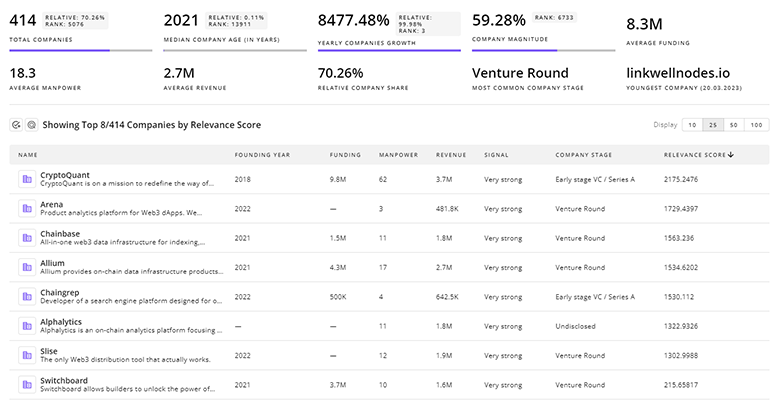
972 Retail AI Companies
Discover Retail AI Companies, their Funding, Manpower, Revenues, Stages, and much more
Retail AI Investors
The Investors tool by TrendFeedr offers a detailed perspective on 940 Retail AI investors and their funding activities. Utilize this tool to dissect investment patterns and gain actionable insights into the financial landscape of Retail AI.
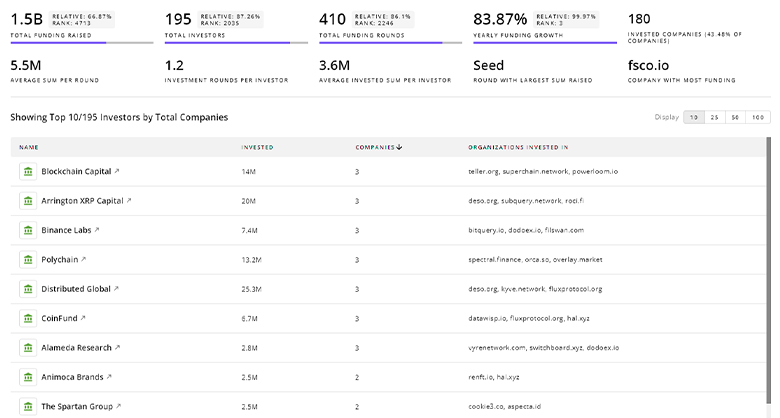
940 Retail AI Investors
Discover Retail AI Investors, Funding Rounds, Invested Amounts, and Funding Growth
Retail AI News
TrendFeedr’s News feature allows you to access 1.1K Retail AI articles as well as a detailed look at both historical trends and current market dynamics. This tool is essential for professionals seeking to stay ahead in a rapidly changing environment.
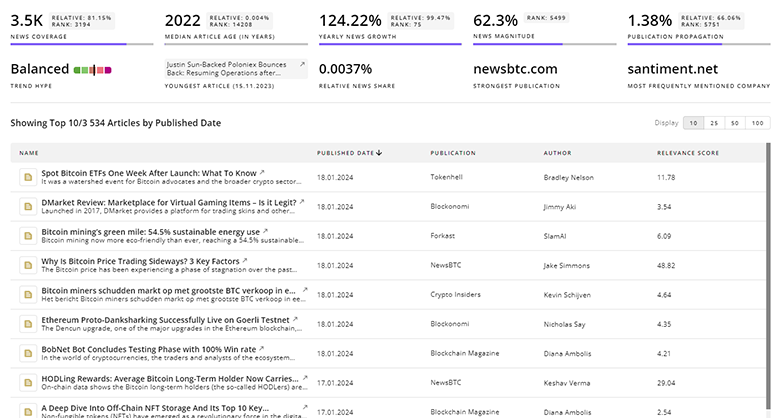
1.1K Retail AI News Articles
Discover Latest Retail AI Articles, News Magnitude, Publication Propagation, Yearly Growth, and Strongest Publications
Executive Summary
Investment, patents and product roadmaps show that retail AI has moved from feature experiments to operational systems that directly tie perception to action. Firms that secure clean, unified product and transaction data and layer low-latency vision with prescriptive agents will convert efficiency gains into sustained margin improvement. For retailers, the immediate playbook is pragmatic: prioritize SKU-level data hygiene, choose vision partners that minimize field retraining, and pilot agentic automation on high-frequency operational bottlenecks (shelf compliance, frontline loss prevention, and replenishment). For vendors, differentiation will come from building defensible data assets, fast model onboarding (synthetic-data workflows), and managed deployment paths that let mid-market retailers participate without heavy capex. The next wave of winners will be those that prove measurable cash flow impact within a single fiscal quarter while maintaining transparent governance and customer trust.
Partner with us to offer cutting-edge insights into trends and tech. We welcome your input.