Web3 Report
: Analysis on the Market, Trends, and TechnologiesThe Web3 market is moving from experimental pilots to infrastructure-led commercialization, anchored by a 2025 market size of $6,150,000,000 and a CAGR of 38.4%, which signals both a rapidly expanding addressable market and a narrowing set of commercial use cases that capture enterprise budgets. This report integrates market forecasts, infrastructure signals, security demand curves, and company-level activity to show that practical usability (account abstraction, W3aaS delivery) and cross-chain utility are now the primary selectors of winner-take-most platform economics.
36 days ago, we last updated this report. Notice something that’s not right? Let’s fix it together.
Topic Dominance Index of Web3
To understand the relative impact of Web3 relative to other known Trends and Technologies, our Dominance Index examines three correlated timelines: the volume of articles published, the number of companies founded, and the intensity of global search interest.
Key Activities and Applications
- Frictionless user onboarding and smart-account tooling: smart contract wallets with gas-sponsorship and social login enable mainstream users to interact with dApps without seed-phrase trauma; solutions in this space accelerate enterprise pilots and consumer conversions.
- Decentralized Finance (DeFi) primitives and institutional rails: lending, staking, derivatives, and custody tooling continue to absorb capital and institutional attention, with specialized automation (scheduled payments, stop-loss) increasing the range of feasible financial services.
- Decentralized identity and compliant data management: enterprises require verifiable credential flows and on-chain anchoring for auditability; GDPR/HIPAA-aware data anchoring and verifiable lineage are moving from proof-of-concept to procurement criteria.
- Cross-chain interoperability and programmable storage: transfer rails and L2 storage layers are being deployed to let applications span chains and host large datasets without prohibitive cost or latency.
- Decentralized infrastructure (RPC, dRPC, DePIN): decentralized RPC relays, node-as-a-service, and edge/DePIN networks are emerging to replace single-provider bottlenecks and lower operating costs for protocol-backed services.
- Security & continuous assurance: continuous monitoring, contest-based audits, MPC wallets, and ZK advances are now procurement items for any project with real liquidity.
- Creator and media monetization platforms: tokenized rights, NFT gating for commerce, and creator-aligned marketplaces are moving into enterprise content strategies, with new monetization models for IP and digital experiences Web3 in Entertainment & Media.
Emergent Trends and Core Insights
- Platform consolidation around developer UX and integrated stacks: market activity shows a pivot from single-purpose primitives to full-stack platforms offering onboarding, payments, and deployment pipelines; this reduces friction for enterprise adoption and squeezes stand-alone tooling margins thirdweb.
- Intent-driven automation and event-execution: protocols that execute on intent (timed orders, cross-chain triggers) are gaining product-market fit, enabling richer DeFi and subscription economics without custodial exposure Ava Protocol.
- Privacy-preserving connectivity as a commercial requirement: demand for zero-knowledge and confidential compute is increasing in verticals with regulated data (finance, health), making ZK stacks and enterprise anchoring competitive differentiators.
- Security becomes a baseline procurement line item: continuous auditing, decentralized contest-based testing, and AI-driven monitoring reduce exploit risk and are required by institutional partners before integrations proceed.
- Geographic and sectoral demand divergence: APAC, parts of LATAM, and Africa show faster user growth and creative product-market fits for payments and DePIN use cases, while North America drives enterprise integration and W3aaS consumption Web3 Market report.
- Talent and operational scaling are rate limiters: funding continues but headcount growth and specialized engineering bandwidth lag—this creates acquisition opportunities for teams that package proven developer experiences into W3aaS offerings.
Technologies and Methodologies
- Account Abstraction (ERC-4337) and smart-account SDKs — remove key-management friction and enable sponsored gas flows; central to consumer onboarding strategies ZeroDev.
- Zero-Knowledge Proofs and zk-acceleration — used to preserve privacy and compress proofs for scalable state verification; a commercial necessity for regulated verticals and metered L2s.
- First-party oracle architectures — direct API-to-chain feeds reduce centralised oracle risk and enable compliant data provisioning to smart contracts api3.
- Programmable storage L2s and data availability layers — off-chain storage with verifiable anchoring supports large datasets, NFT metadata, and enterprise audit trails EthStorage.
- TypeScript on-chain execution and familiar dev stacks — enabling larger developer pools to build secure contracts by running higher-level languages in VMs reduces onboarding friction for teams.
- Decentralized RPC networks and pay-as-you-go node services — distributed relays and RPC load balancing lower outage and cost risk compared to single-provider dependencies.
- AI integration for automated portfolio/DeFi management — AI co-pilots curate yield strategies and manage on-chain income streams without custody, improving retail and DAO outcomes maneki.garden.
Web3 Funding
A total of 6.5K Web3 companies have received funding.
Overall, Web3 companies have raised $263.1B.
Companies within the Web3 domain have secured capital from 20.5K funding rounds.
The chart shows the funding trendline of Web3 companies over the last 5 years
Web3 Companies
- Weavechain — Weavechain provides enterprise-ready, verifiable data anchoring that transforms traditional databases into auditable Web3 data layers; the product emphasizes GDPR/HIPAA compliance with blockchain anchoring to create verifiable lineage and oracle links. Its approach targets regulated verticals that cannot accept raw public ledgers while wanting the auditability benefits of on-chain proofs. This company matches enterprise procurement cycles and positions data provenance as a commercial feature.
- Viper network — Viper network is an RPC relay and decentralized node-incentivization protocol that routes traffic through distributed node providers to reduce single-point outages and resell node capacity. It aims to convert node operators into revenue-bearing participants, which supports DePIN-style economics for RPC and reduces reliance on centralized providers. That model directly maps to the infrastructure activity of decentralized RPC services and pay-as-you-go node balancing.
- Sonet — Sonet builds open-source middleware to bridge Web3 features into Web2 social platforms, offering SDKs and entry points to embed wallets, token gating, and identity flows into messaging networks like Telegram. Its value proposition is enabling consumer-facing dApps to reach existing social graphs without forcing users through separate installs, an essential commercialization path for creator and media use cases. Sonet's multi-chain deployment strategy targets rapid audience reach for tokenized engagement models.
- Secure3 — Secure3 runs contest-based, incentive-driven smart contract audits that mobilize high-quality auditors through competitive reward mechanisms. That model lowers audit costs for early-stage teams while improving the detection rate for critical vulnerabilities, addressing the market's increasing security procurement needs for DeFi and marketplace projects. Secure3 fits the market signal placing security as a non-negotiable procurement requirement.
- Hyperweb — Hyperweb brings TypeScript execution on-chain, enabling developers to write contracts in a familiar language and deploy within a JavaScript VM, which broadens the addressable engineering population. By reducing the cognitive friction of specialized smart-contract languages, Hyperweb accelerates cross-chain application development and supports interchain composition patterns. This approach directly addresses the talent bottleneck by lowering the experience threshold for secure smart contract production.
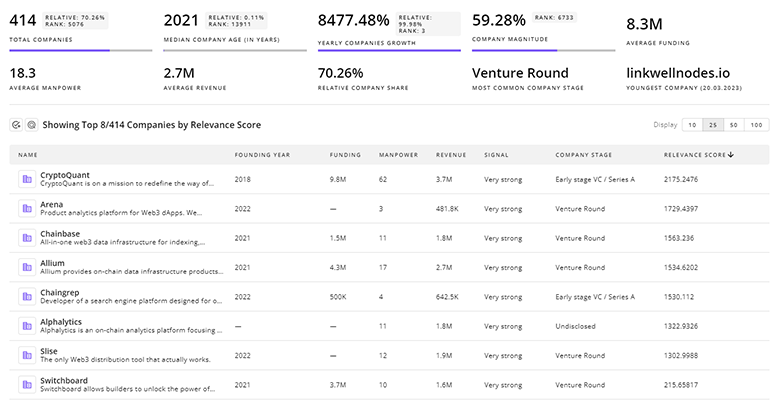
TrendFeedr’s Companies feature offers comprehensive insights into 31.7K Web3 companies.
31.7K Web3 Companies
Discover Web3 Companies, their Funding, Manpower, Revenues, Stages, and much more
Web3 Investors
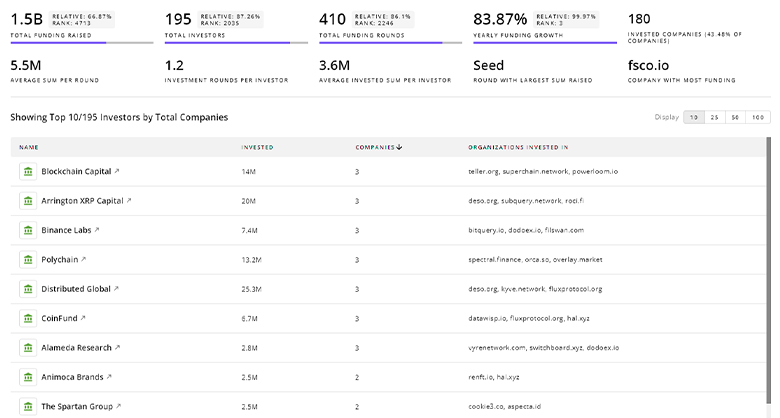
TrendFeedr’s Investors tool offers you a detailed perspective into 19.8K Web3 investors and their funding activities. This information enables you to analyze investment trends and make informed decisions in the Web3 market.
19.8K Web3 Investors
Discover Web3 Investors, Funding Rounds, Invested Amounts, and Funding Growth
Web3 News
TrendFeedr’s News feature delivers access to 52.1K articles focused on Web3. Use this tool to stay informed about the latest market developments and historical context, which is crucial for strategic decision-making.
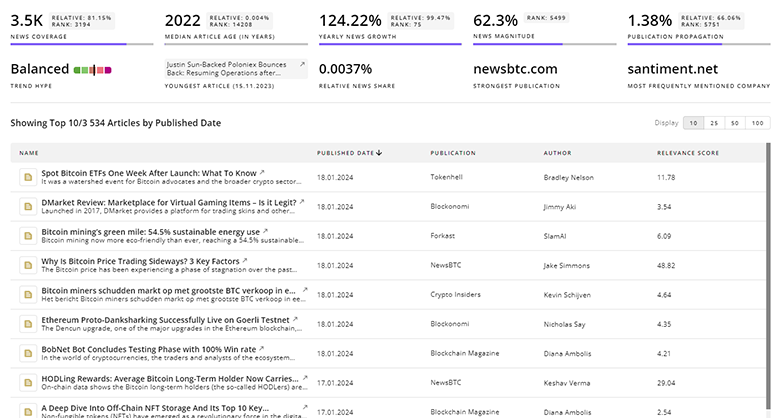
52.1K Web3 News Articles
Discover Latest Web3 Articles, News Magnitude, Publication Propagation, Yearly Growth, and Strongest Publications
Executive Summary
Web3 has entered an infrastructure consolidation phase where usability, compliance, and multi-chain utility determine commercial outcomes. Market data show strong growth projections and sustained investor engagement, but widespread adoption requires converting developer investments into simple, auditable products for enterprise buyers and mainstream users. Companies that combine seamless onboarding (smart accounts), compliant identity, verifiable storage, and continuous security will secure enterprise contracts and the recurring revenue that defines platform leaders. Strategic capital deployed to integrate these capabilities into turnkey W3aaS products will deliver the most defensible commercial positions in the coming five years.
We're looking to collaborate with knowledgeable insiders to enhance our analysis of trends and tech. Join us!